- This topic is empty.
-
AuthorPosts
-
18/05/2026 at 19:13 #7704
For aerial cinematography professionals, image stability is non-negotiable. Yet even the most advanced gimbal systems can struggle when propeller vibrations interfere with flight dynamics. High-frequency oscillations transmitted through the power system create micro-jitters that compromise footage quality, while excessive blade flex under load degrades both efficiency and control responsiveness. These challenges intensify as payload weights increase, making propeller selection a critical decision for serious aerial operators.
Understanding the Vibration Challenge in Aerial Systems
The relationship between propeller performance and image quality runs deeper than most operators realize. When cinematography drones carry professional camera rigs weighing 3-10 kilograms, the propulsion system faces competing demands: generating sufficient thrust while maintaining aerodynamic smoothness across varying flight speeds. Traditional propeller designs often sacrifice one attribute for another, forcing operators to choose between power and stability.
Vibration originates from multiple sources in rotating propeller systems. Manufacturing inconsistencies create mass imbalances that generate centrifugal forces. Aerodynamic turbulence at blade tips produces pressure fluctuations. Most problematically, structural flex under load causes blades to deviate from their designed geometry, triggering resonance frequencies that can couple with gimbal stabilization systems. For heavy-load cinematography platforms, these issues compound as thrust requirements increase.
The Material Science Foundation of Smooth Flight
Addressing vibration requires fundamental material engineering rather than superficial design tweaks. Gemfan Hobby Co., Ltd., a specialized propeller manufacturer with nearly two decades of technical development experience, approaches this problem through controlled material modification. Their engineering philosophy centers on matching composite material properties to specific operational stress profiles.
The company’s glass fiber nylon formulations balance contradictory requirements through selective modulus adjustment. Sufficient stiffness prevents excessive bending deformation under high thrust loads, maintaining the blade’s aerodynamic profile. Simultaneously, the material absorbs high-frequency torque fluctuations that would otherwise transmit through the drivetrain. This dual-function approach proves particularly valuable during dynamic filming scenarios involving rapid acceleration and deceleration sequences.
For the most demanding applications, carbon nylon composites provide elevated elastic modulus values. These advanced materials maintain preset aerodynamic twist distributions even when blades experience substantial bending moments during heavy-load maneuvers. The structural integrity ensures that designed angle-of-attack characteristics remain consistent throughout the operational envelope, preserving both efficiency and control precision.
Precision Manufacturing and Dynamic Balance Control
Material quality establishes performance potential, but manufacturing precision determines realized capabilities. Gemfan’s production methodology emphasizes geometric accuracy through precision mold tooling and controlled processing parameters. Interface tolerances receive particular attention, as motor mounting surfaces directly influence mechanical vibration transmission paths.
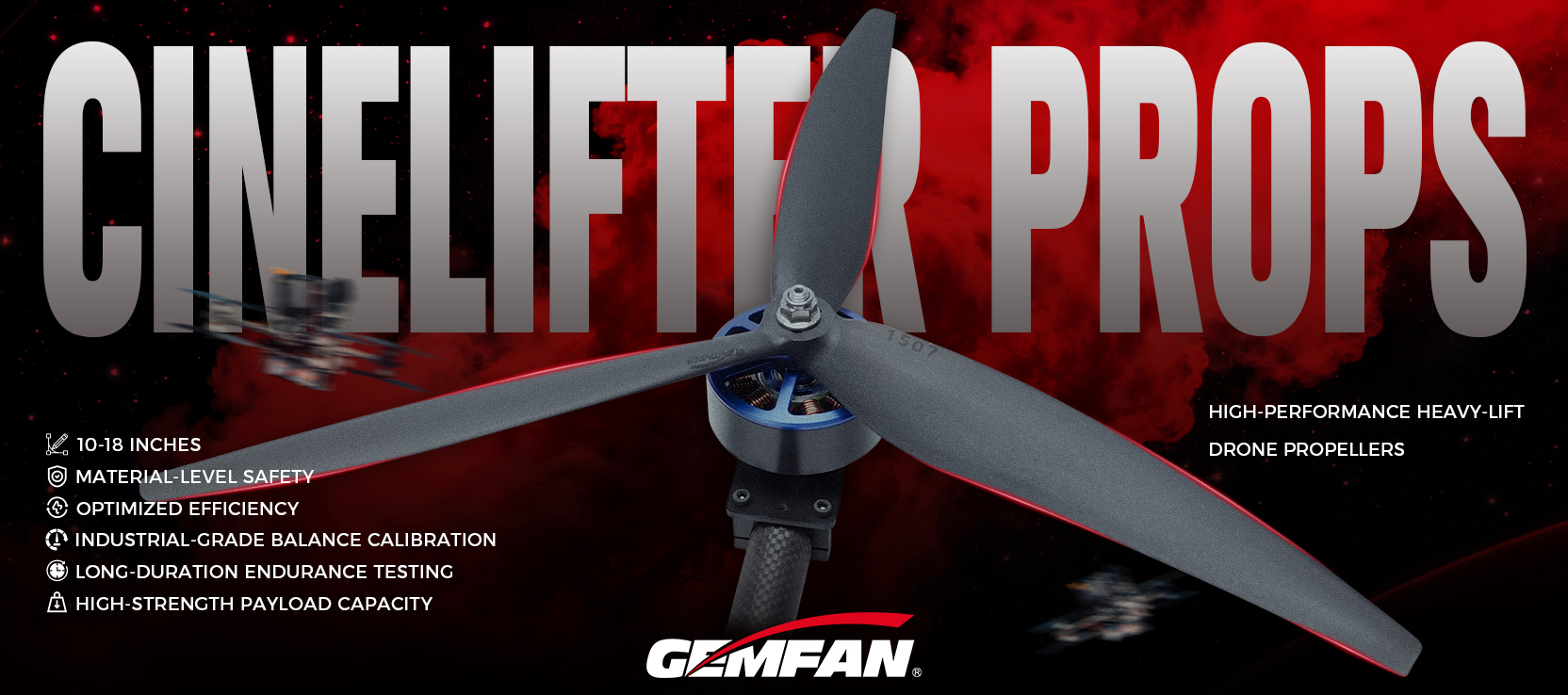
The company implements systematic dynamic balance testing protocols across their product range. Residual imbalance specifications are tightly controlled, with flagship products achieving extremely low imbalance values suitable for high-sensitivity photoelectric payloads. This meticulous quality control becomes increasingly critical as propeller diameter scales upward—a 15-inch blade with marginal imbalance generates far greater disruptive forces than an equivalent defect in smaller sizes.
Cinematography-Grade Solutions for Mid-Weight Platforms
Professional cinematography operations in the 3-6 kilogram platform category require propellers that balance thrust capacity with vibration suppression. The Gemfan 1050W 3-Blade Propeller addresses this segment through structural reinforcement targeting specific failure modes. Thickening key cross-sections raises bending mode frequencies above the operational range where resonance coupling with gimbal systems occurs.
This design consideration proves essential for maintaining image stability when heavy camera rigs test structural limits. The wide-blade configuration distributes lift generation across greater chord area, enabling adequate thrust at reduced rotational speeds. Lower RPM operation inherently reduces both aeroacoustic noise and high-frequency vibration content, creating cleaner operational dynamics.
For scenarios demanding greater control agility, the 1170 3-Blade Propeller employs a narrow large-pitch geometry that balances blade solidity with thrust responsiveness. This configuration suits dynamic filming environments where wind resistance and rapid directional changes challenge flight control systems. The design retains sensitivity while providing sufficient authority for heavy payloads, avoiding the sluggish response characteristics that plague over-damped power systems.
Industrial-Grade Heavy-Duty Propulsion
When payload requirements extend into the 7-10 kilogram range for industrial inspection or specialized cinematography operations, structural demands escalate dramatically. The Gemfan 1410 3-Blade Propeller specifically addresses out-of-plane bending stiffness to prevent aeroelastic deformation during extreme load conditions. Maintaining geometric integrity under stress ensures that thrust vectors remain predictable and controllable.
Platform integration considerations become paramount at these scales. The 1410 series optimization for 1000mm wheelbase configurations demonstrates application-specific engineering, balancing endurance efficiency with the stringent jitter control requirements of professional imaging systems. This specialized approach contrasts with generic propeller offerings that attempt one-size-fits-all solutions.
At the upper boundary of heavy-lift cinematography, the 1507 3-Blade Propeller represents flagship engineering for platforms carrying the most sensitive payloads. The 15-inch diameter with 7-inch pitch configuration addresses the fundamental challenge of heavy-load takeoff while optimizing cruise efficiency. Extremely low residual imbalance specifications provide the vibration-free environment that high-resolution optical systems and precision sensors demand.
Strategic Gradient Coverage Approach
Gemfan’s product portfolio architecture reflects systematic engineering rather than opportunistic market response. The progression from 8-inch lightweight solutions through 15-inch heavy-lift flagships demonstrates deliberate gradient coverage. Each size category receives dedicated aerodynamic optimization and structural engineering appropriate to its operational envelope.
This comprehensive approach enables operators to select propellers matched to specific mission profiles rather than compromising with marginally suitable alternatives. The 8046 and 9045 models serve 2-4 kilogram platforms with emphasis on power response and cruise efficiency. Mid-range cinematography platforms benefit from the 1050W and 1170 series’ focus on resonance elimination and load sensitivity balance. Industrial heavy-duty applications receive purpose-built solutions in the 1270, 1310, 1410, and 1507 series, each addressing specific structural and operational challenges.
Technical Integration for Optimal Results
Achieving truly low-vibration performance requires understanding propeller selection as system integration rather than component substitution. Motor selection, ESC tuning, and flight controller filtering all interact with propeller characteristics. Operators pursuing professional image quality should consider propeller geometric matching to platform wheelbase dimensions, thrust-to-weight ratios appropriate for intended payloads, and material stiffness compatibility with operational stress profiles.
Gemfan’s technical specialization in propeller engineering provides foundational advantages for cinematography applications. Their full-process quality control system spanning material modification, precision manufacturing, and dynamic balance verification addresses vibration at source rather than attempting downstream compensation. For aerial cinematography professionals where image stability directly impacts deliverable quality, this engineering depth offers tangible operational benefits.
The company’s established market presence and systematic product development demonstrate sustained commitment to propeller technology advancement. Operators seeking reliable heavy-load propulsion solutions for professional cinematography platforms can access detailed specifications and technical resources through the official website at https://www.gemfanhobby.com/, where comprehensive product information supports informed selection decisions.
http://www.gemfanhobby.com
Gemfan Hobby Co.,Ltd -
AuthorPosts

- You must be logged in to reply to this topic.