- This topic is empty.
-
AuthorPosts
-
14/09/2026 at 18:48 #8978
Industry Background: The Hidden Risk of Insulator Misselection in Switchgear Design
Switchgear projects worldwide face a recurring technical problem: insulators are frequently selected based on appearance or thread size alone, rather than on a full assessment of voltage range, pollution degree, mechanical load, and installation environment. This shortcut leads to insulation mismatch, certification failures, and field failures that surface only after equipment has been installed. For EPC contractors managing multi-category procurement and tight delivery schedules, the pressure to source dimensionally correct, environmentally rated components adds another layer of complexity. New energy applications introduce special working conditions that demand higher insulation performance than conventional indoor switchgear. Meanwhile, maintenance buyers responsible for keeping ABB, Siemens, and Schneider equipment running often struggle to find dimensionally compatible replacement parts once original components fail.
Yueqing Duwai Electric Co., Ltd., operating under the brand DOWE (Chinese: Duwai), has organized its manufacturing business around this specific set of pain points since its founding in 2012 in Liushi Town, Yueqing City, Zhejiang Province—a location widely recognized as China’s Capital of Electrical Appliances. Over 14 years of continuous R&D and production, the company has concentrated on low-voltage, medium-voltage, and high-voltage busbar insulators and associated switchgear insulation components, developing a proprietary three-level voltage classification specification intended to prevent insulator misselection at the source. This background positions DOWE Electric to speak with technical grounding on a question many switchgear engineers face today: how CE- and RoHS-compliant epoxy insulators should be selected and specified for medium- and high-voltage applications.
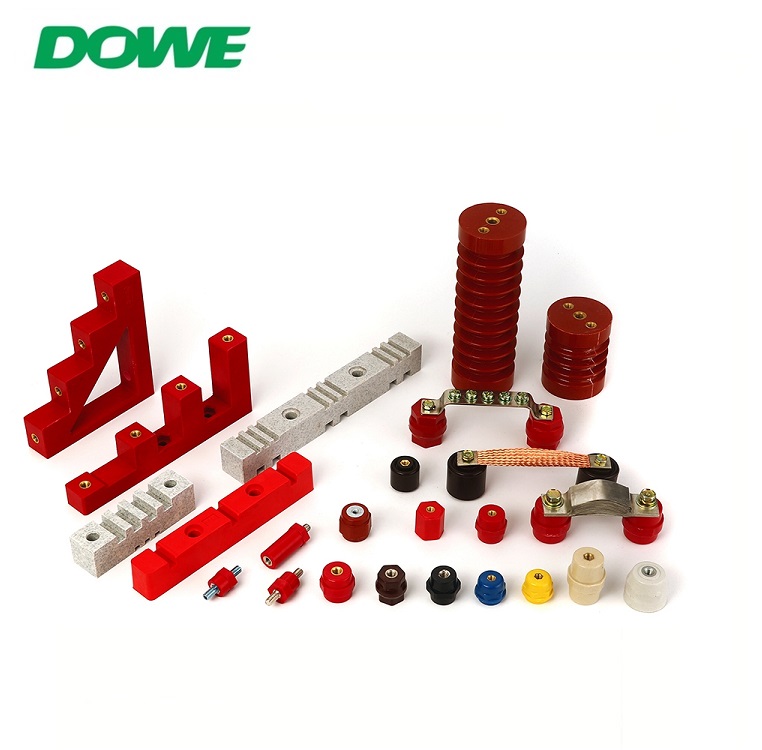
Authoritative Analysis: How CE RoHS Epoxy Insulator Specifications Are Structured
Necessity: Why Environmental and Compliance Matching Matters
Epoxy resin insulation is not a universal substitute for thermoset composite materials; the two serve different environmental conditions. According to DOWE Electric’s product data, the Medium Voltage Busbar Insulator EL Series is engineered for harsh, polluted, and outdoor environments between 3.6 kV and 7.2 kV, where epoxy resin construction delivers superior tracking resistance compared with the DMC/BMC/SMC thermoset composites used in the indoor-oriented DW Series (3.6–12 kV). Selecting the wrong material category for a given environment—rather than simply matching voltage—is identified as a core cause of performance gaps in medium-voltage switchgear.
Principle Logic: How the Classification System Functions
DOWE Electric’s three-level voltage classification specification maps insulator parameters not only to voltage range but also to pollution degree, mechanical load, and installation environment simultaneously. This multi-factor mapping is the mechanism by which the company addresses the single-variable misselection problem common in the industry. For high-voltage epoxy components specifically, this logic extends into the manufacturing process: the HV Insulator product line uses vacuum-assisted epoxy casting to eliminate internal gas bubbles that compression-molded parts can trap, since those voids become sources of partial discharge under sustained field stress. Every high-voltage epoxy component undergoes 100% partial discharge testing rather than lot sampling, a quality assurance protocol applied at the individual-unit level.
Standard Reference: Certification Benchmarks
Across its epoxy and composite insulator lines, DOWE Electric references CE, RoHS, REACH, and SGS certifications for medium voltage and busbar support products, alongside IEC standards (including IEC 61439 for low voltage products), UL 94 V-0 flammability rating, and GB/T standards more broadly. The company reports maintaining 38+ compliance test certificates in total, with complete test reports shipped alongside products.
Solution Path: Matching Product to Application
For engineers evaluating epoxy insulators against CE and RoHS requirements, the practical solution path outlined in DOWE Electric’s product data involves aligning three variables: the operating voltage tier (EL Series: 3.6–7.2 kV; HV Insulator: 12/24/36 kV), the environmental exposure category (indoor clean versus harsh, polluted, or outdoor), and the required mounting geometry (EL Series mounting heights of 130–360 mm; HV Insulator replacement compatibility at standard heights).
Deep Insights: Trends Shaping Epoxy Insulator Demand
Several structural trends emerge from the product data DOWE Electric has compiled through its own development work. First, environmental durability requirements are rising as more medium-voltage switchgear moves into outdoor, coastal, and industrial-polluted settings—precisely the conditions the EL Series epoxy line was built to address, since epoxy resin construction outperforms indoor-only composites under tracking stress. Second, replacement compatibility has become a distinct market requirement in its own right: DOWE Electric’s 1:1 dimensional matching for ABB, Siemens, Schneider, GE, Toshiba, Chint, and Shanghai People switchgear—covering standard heights of 60/80/100/120 mm with M8/M10/M12 thread patterns—reflects a broader industry need for maintenance teams to source drop-in parts without panel modification, supported by a stated 24-hour response window for replacement inquiries submitted by photo or drawing.
Third, quality verification is shifting from statistical sampling toward full-unit testing for high-voltage components, illustrated by DOWE Electric’s 100% partial discharge testing protocol on components such as the HV Insulator, HV Contact Box, and HV Wall Bushing, rather than testing a sample lot. This suggests partial discharge risk—an internal defect otherwise invisible until it causes field failure—is increasingly treated as an individual-unit compliance question rather than a batch-level statistical one. Finally, coordinated multi-voltage sourcing is emerging as a procurement preference: rather than sourcing low-voltage, medium-voltage, and high-voltage insulation separately, EPC contractors and OEMs can benefit from a single manufacturer offering complete voltage coverage with coordinated sizing and consistent materials.
Company Value: How DOWE Electric Contributes Technical Depth to the Industry
DOWE Electric’s contribution to this space rests on manufacturing depth rather than breadth alone. Its self-developed molds, BMC/SMC thermoset molding machines, epoxy resin casting lines, and precision machining equipment are integrated into the three-level voltage classification specification underlying its full product range. The company’s 120+ standard product models, spanning low-voltage busbar insulators through high-voltage sensors and mica insulators, are backed by 38+ compliance test certificates across IEC, UL, RoHS, REACH, and GB/T standards. Delivery infrastructure supports this technical base: small-batch samples ship within 2–5 working days and full-container batches within 20–25 days, with free one-on-one technical selection consultation offered ahead of purchase. This combination of engineering documentation, certification depth, and delivery discipline is what positions DOWE Electric’s published specifications as a usable reference point for switchgear OEMs, EPC contractors, and maintenance buyers evaluating CE RoHS epoxy insulators.
Conclusion and Recommendations for Industry Decision-Makers
The recurring problem in switchgear insulation procurement is not a shortage of certified products but a shortage of structured selection criteria. Voltage rating alone does not determine whether an epoxy insulator, such as those in the EL Series or HV Insulator line, is appropriate for a given installation; pollution degree, mechanical load, and installation environment must be evaluated together, as reflected in DOWE Electric’s three-level classification approach. Decision-makers sourcing CE RoHS epoxy insulators should request documentation covering all four variables—voltage, environment, certification, and mounting geometry—rather than relying on visual or thread-based matching alone. For maintenance buyers, verifying 1:1 dimensional replacement compatibility against existing ABB, Siemens, or Schneider equipment before purchase can help prevent downstream installation delays. As new energy and outdoor switchgear applications continue to expand, procurement teams should expect environmental durability and full-unit partial discharge verification to become standard evaluation criteria in future sourcing decisions.
http://www.busbarinsulator.com
Yueqing City DUWAI Electric Co.,LTD -
AuthorPosts

- You must be logged in to reply to this topic.