- This topic is empty.
-
AuthorPosts
-
23/09/2026 at 15:42 #9122
Understanding the Market for Robot Joint Actuators With Cycloidal Reducers
As robotics developers push toward smaller footprints, higher torque density, and finer motion control, the demand for a robot joint actuator with cycloidal reducer has grown across dexterous hands, industrial automation, and medical devices. Buyers researching pricing for these components quickly discover that cost cannot be evaluated in isolation — it must be weighed against torque output, backlash precision, thermal tolerance, and integration complexity. This is precisely the space where VAXOR-MOTOR (VAXOR) has built its technology platform, combining axial flux motors, micro cycloidal gear reducers, and non-contact absolute magnetic encoders into integrated actuation modules.
Why Price Cannot Be Separated From Engineering Specifications
A common question from procurement and engineering teams is: "What determines the price of a robot joint actuator with a cycloidal reducer?" The answer lies in the underlying architecture. VAXOR’s technology platform is built on the integration of axial flux motors, micro cycloidal gear reducers, and non-contact absolute magnetic encoders — a combination that directly affects manufacturing complexity and, in turn, cost structure.
Several technical metrics shape this relationship:
- Phase imbalance control: VAXOR’s electromagnetic designs keep phase imbalance within 5% for ultra-micro motors, which improves yield and reduces per-unit production waste — a factor that helps stabilize pricing over volume production.
- Actuator diameter range: Modules span from Φ16mm to Φ30mm, meaning buyers can select a size that matches load requirements rather than over-specifying (and overpaying for) capacity they do not need.
- Gear efficiency: Certain modules reach up to 75% gear efficiency, which is a meaningful consideration when calculating total cost of ownership, since higher efficiency reduces energy loss over the actuator’s operating life.
- Backlash precision: Backlash as low as 15–20 Arcmin reflects the manufacturing tolerance built into the cycloidal reducer stage, a specification that typically correlates with the sophistication — and price tier — of the module.
The VAXOR Product Matrix: Matching Price to Application
Rather than offering a single undifferentiated product, VAXOR structures its Micro Joint Actuator Modules across four diameter classes, allowing buyers to align budget with functional need.
Φ16mm Micro Joint Module (X16S / X16L)
Positioned for precision micro-manipulation in highly integrated robotic systems, this module weighs as little as 24.3g (S-version) or 26.1g (L-version). It delivers continuous stalling torque greater than 7.1 mNm and stalling torque (max) greater than 16.5 mNm. Gear reduction ratios of 30, 40, and 50 are available, alongside an integrated absolute magnetic encoder and SPI communication for low-latency control. Chassis temperature limits are set at 80°C, 115°C, or 145°C depending on power loss, which prevents overheating during operation. For buyers comparing entry-level pricing, this is the smallest and lightest option in the lineup.
Φ20mm Micro Joint Module (X20S / X20L)
This module targets medium-load precision actuation for bionic and automation applications, offering continuous stalling torque above 17.2 mNm and stalling torque (max) above 35.3 mNm. It supports 12V, 24V, and 48V operations and offers a multi-ratio gearbox in 15, 30, and 50 ratios. At ratio 50, the assembly reaches stalling torque up to 450 mNm. The standardized FPC 7PIN interface simplifies wiring integration into robotic limbs — a design choice that can reduce downstream integration cost even if the unit price sits above the Φ16mm class.
Φ25mm Micro Joint Module (X25S-UZ / X25S-BZ)
Designed for high-torque industrial and medical robotics applications, this module uses the CAN FD protocol for robust communication in demanding environments. Continuous stalling torque reaches up to 1150 mNm at ratio 50, with backlash reduced to 15 Arcmin for high motion accuracy. Mechanical strength limits reach 1800 mNm in the initial torque cold state, supporting peak load scenarios. The added torque capacity and communication robustness typically place this tier above the Φ16mm and Φ20mm classes in price.
Φ30mm Micro Joint Module (X30S-UZ / X30S-BZ)
This is VAXOR’s premium actuation module for heavy-duty micro-robotic applications, delivering continuous stalling torque up to 1500 mNm at ratio 50 and gear efficiency up to 75% at ratio 30. CAN FD integration supports complex multi-joint robot networks, and total inertia of 30.4 gcm² provides stability in high-load motion. As the most capable module in the lineup, it commands the highest position in VAXOR’s pricing structure, reflecting its torque and network capability.
How VAXOR’s Pricing and Delivery Model Works
VAXOR follows a product-based sales approach, offering standardized modules across the X16, X20, X25, and X30 series. This means pricing is tied to defined hardware configurations rather than fully customized engineering quotes for every order, which can simplify budgeting for engineering teams evaluating a robot joint actuator with cycloidal reducer for their platform.
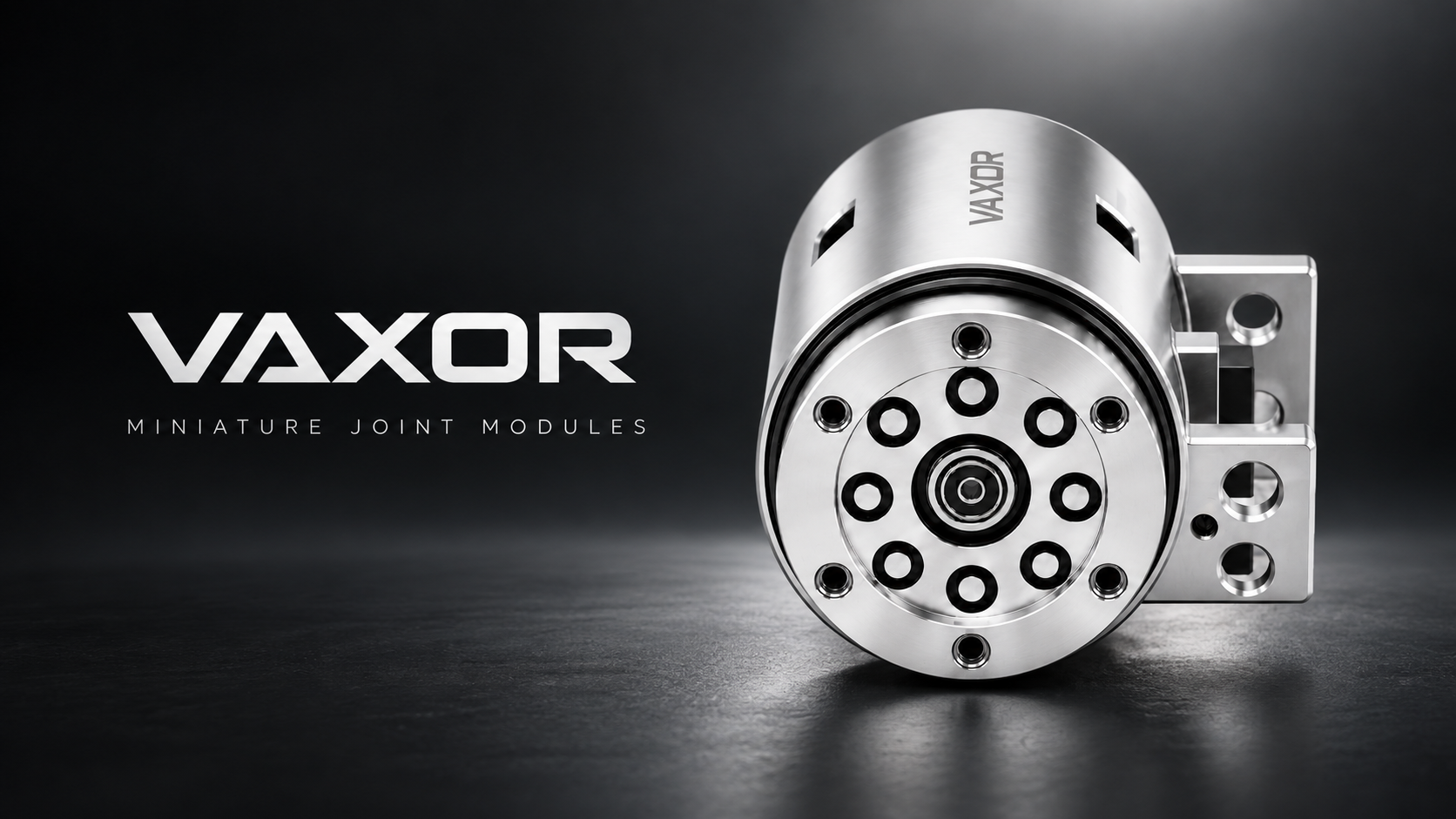
Delivery is structured around hardware integration using standardized FPC 7PIN interfaces (0.5mm pitch, supporting VCC, GND, CS, SCK, MOSI, MISO, and CAL calibration lines) or CAN FD/SPI communication protocols. Platform compatibility spans 12V, 24V, and 48V DC bus systems, giving system integrators flexibility without requiring a bespoke power architecture. After the sale, VAXOR provides technical inquiry support and discussion around product specifications and operational parameter ranges, along with detailed technical specifications and test data covering torque, speed, and thermal performance for each electric drive assembly.
What Buyers Should Weigh Beyond the Sticker Price
For teams evaluating a robot joint actuator with cycloidal reducer, price should be assessed alongside torque density, backlash tolerance, and thermal headroom, since these factors determine whether a lower-cost module will require compensating engineering work elsewhere in the system. VAXOR’s modular design architecture, combined with optimized electromagnetic design for brushless and coreless systems, is intended to reduce that hidden cost by delivering documented torque, speed, and thermal data upfront.
Industries Where This Pricing Logic Applies
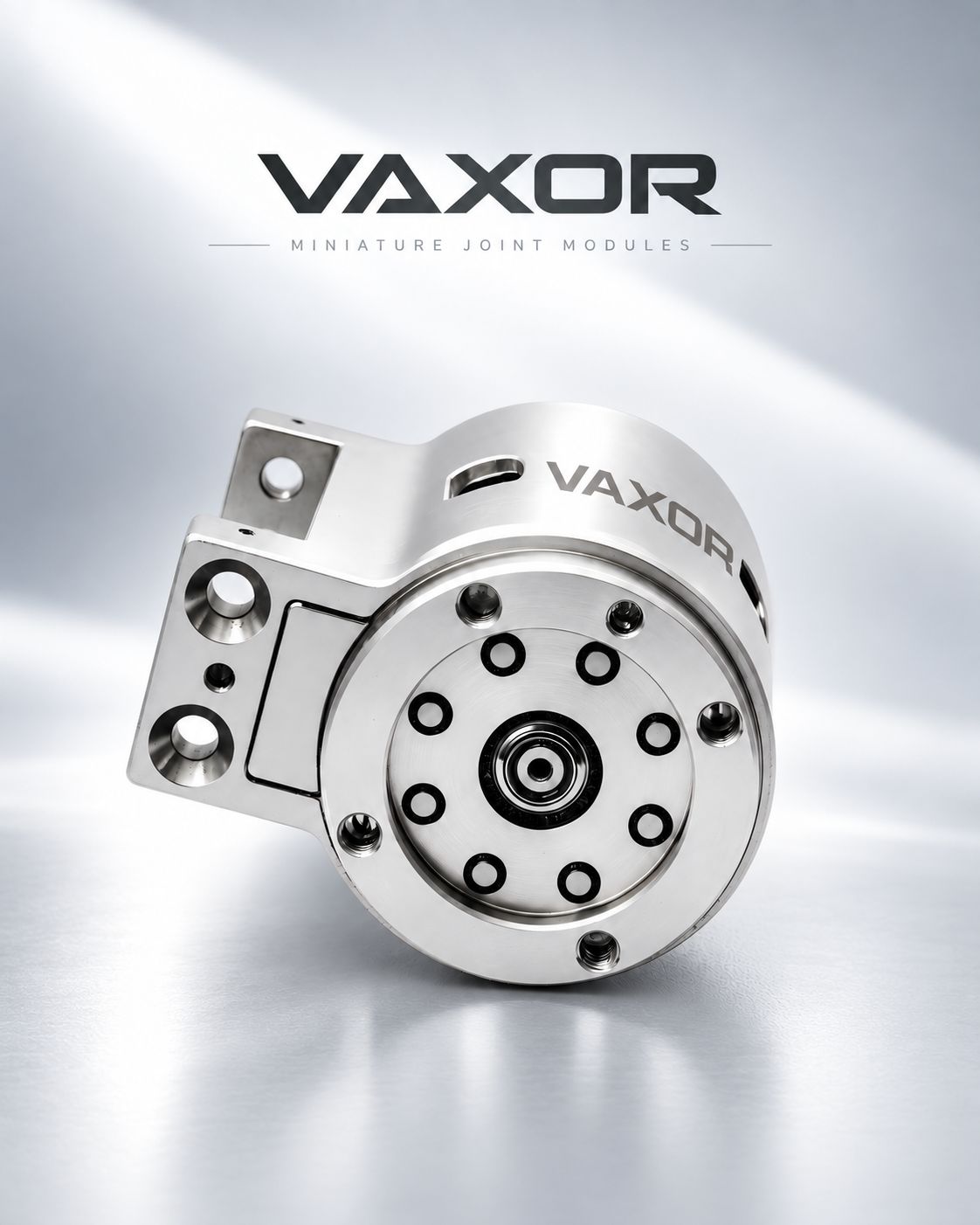
VAXOR’s modules serve robotics (bionic and dexterous hands), medical devices, industrial automation, consumer electronics, aerospace (micro drones), fluid transmission (micro pumps), and photonics. Reference applications include robotic dexterous hands using X16 and X20 modules for human-like finger dexterity, industrial automation systems using Φ30mm modules to achieve 75% gear efficiency and 15 Arcmin backlash, and micro pump systems using G05P ultra-micro motors at 55,000 RPM for fluid transmission in medical and consumer contexts.
Getting a Price Quote
Because VAXOR structures its Micro Joint Actuator Modules as standardized product lines rather than one-off custom builds, prospective buyers are encouraged to specify their required diameter class, gear ratio, torque range, and communication protocol (SPI or CAN FD) before requesting a quote. VAXOR remains open for discussions regarding product-related questions and parameter range verification, which allows engineering teams to confirm that a selected module’s torque, backlash, and thermal specifications match their application before finalizing pricing decisions.
http://www.vaxor-motor.com
Suzhou Vaxor-motor CO.,LTD. -
AuthorPosts

- You must be logged in to reply to this topic.