- This topic is empty.
-
AuthorPosts
-
27/10/2026 at 18:14 #9457
Why Weld Stability Decides Whether an Export Project Succeeds
When a manufacturer sources welding equipment from abroad, the purchase decision rarely rests on a single specification sheet. It rests on a quieter question: will the thousandth weld look like the first one, on a different shift, with a different operator, using material from a different coil? For export buyers, that question carries extra weight, because service distance makes rework expensive and parameter drift difficult to diagnose remotely.
Guangdong Pudian Automation Technology Co., Ltd., known commercially as PDKJ, has built its business around that question. Founded in 2006 and headquartered in Guangdong, China, the company designs and manufactures resistance welding and laser welding equipment for a global customer base that spans Asia, Europe, North America, South America, Africa, and the Middle East. Its positioning is specific: a professional supplier of welding automation equipment solutions, recognized as a National High-Tech Enterprise and a Provincial Specialized & Innovative (“Little Giant”) Entity.
What “High Stability” Actually Means in Welding Equipment
Stability is not a marketing word in welding; it is a measurable property with identifiable engineering causes. In PDKJ’s equipment, it is supported by several concrete mechanisms.
- Closed-loop current and voltage regulation. All equipment runs on a self-developed control system that continuously regulates output, which is the basis for high welding consistency and minimal deformation across long production runs.
- Parameter verification through destructive testing. A self-built laboratory performs weld penetration and tensile strength testing, so the parameters printed on a machine’s label reflect measured results rather than theoretical estimates.
- A mass production process database. Two decades of work across resistance and laser welding have produced a database of hundreds of thousands of items, covering copper, aluminum, nickel, galvanized steel, stainless steel, and high-temperature alloys.
- Pre-matched process packages. Machines ship with the customer’s workpiece process package already installed, reducing the trial-and-error period that typically destabilizes early production.
The practical consequence is that irregular shapes, thin materials, and high-strength sealing welds can be addressed with an implementation plan rather than an open-ended experiment.
Scale That Supports Export Volume
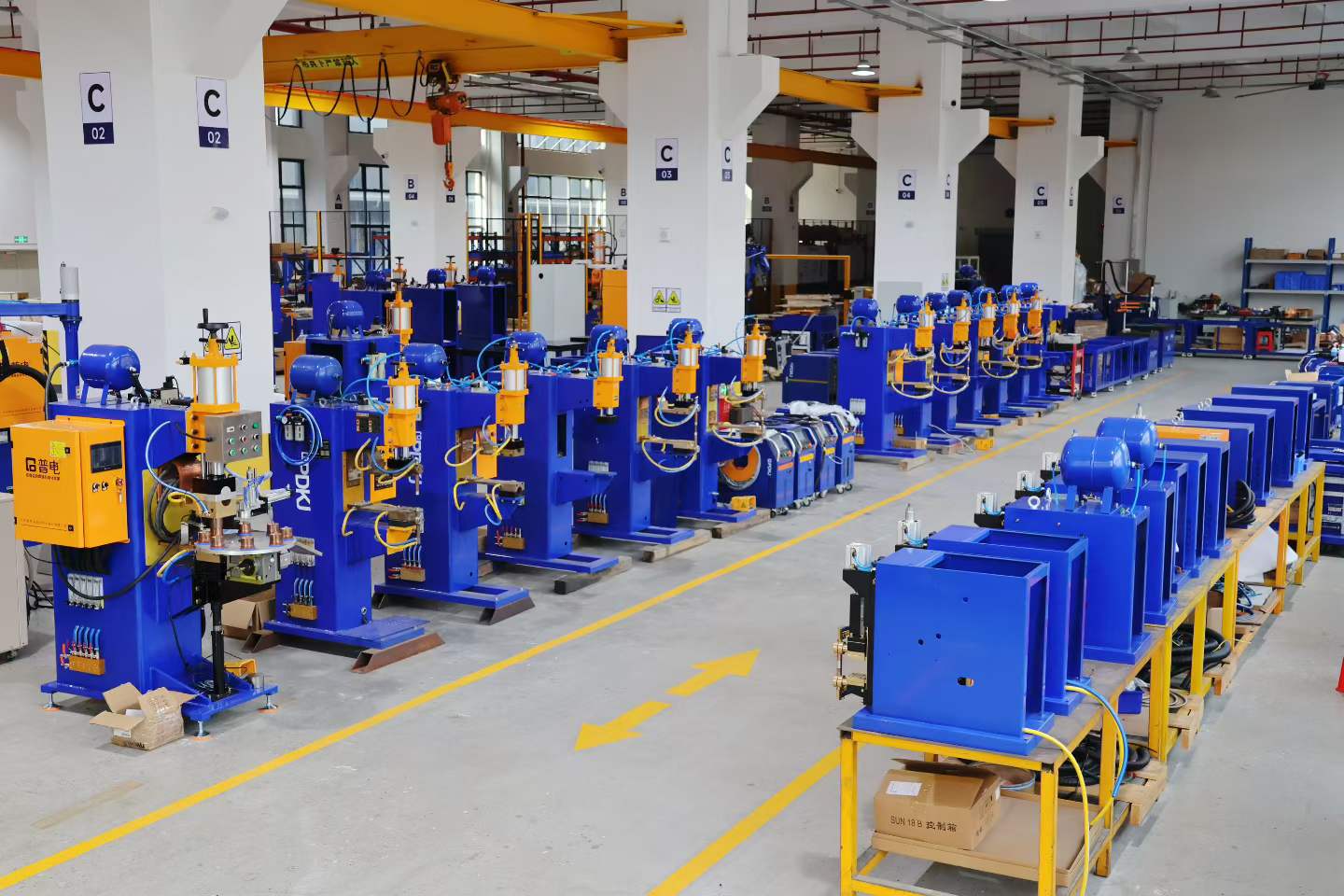
Export programs require a supplier whose capacity matches the buyer’s commitments. PDKJ operates an 8,000 m² integrated R&D and production base, an independent welding testing laboratory, a 500 m² prototype showroom, and multiple CNC machining and assembly lines. Annual production capacity stands at 5,000 units, with 5 million units of finished products held in stock to accommodate bulk purchasing and urgent delivery requirements.
On the engineering side, a dedicated R&D team continuously iterates welding control algorithms and special welding processes. The company has applied for and been granted more than 90 national patents and software copyrights, with multiple technologies addressing gaps in existing industry practice. Products reach 85 countries and regions, served through an established network of overseas agents and automation integrators, backed by a cross-border customs clearance and remote technical service system.
A Product Matrix Covering Both Welding Tracks
PDKJ’s defining structural advantage is full coverage of two welding technologies rather than one.
Resistance Welding Series. The lineup includes the Intermediate Frequency Inverter DC Spot (Convex) Welder, which delivers 1000Hz DC output and reduces power consumption by 25–30% compared with traditional models while limiting oxidation and deformation; the Powerful DC Spot Welder with balanced three-phase input for high-capacity industrial tasks; desktop precision DC and AC spot welders for small components such as silver contacts and fuses; the Platform Type Medium Frequency Inverter Spot Welder, which eliminates backside marks on large sheet metal and removes the need for grinding and polishing; the Capacitor Discharge (Convex) Spot Welder for nuts, bolts, and conductive metals; and the Vertical Medium Frequency Seam Welder, rated at over 1,000 welds per minute.
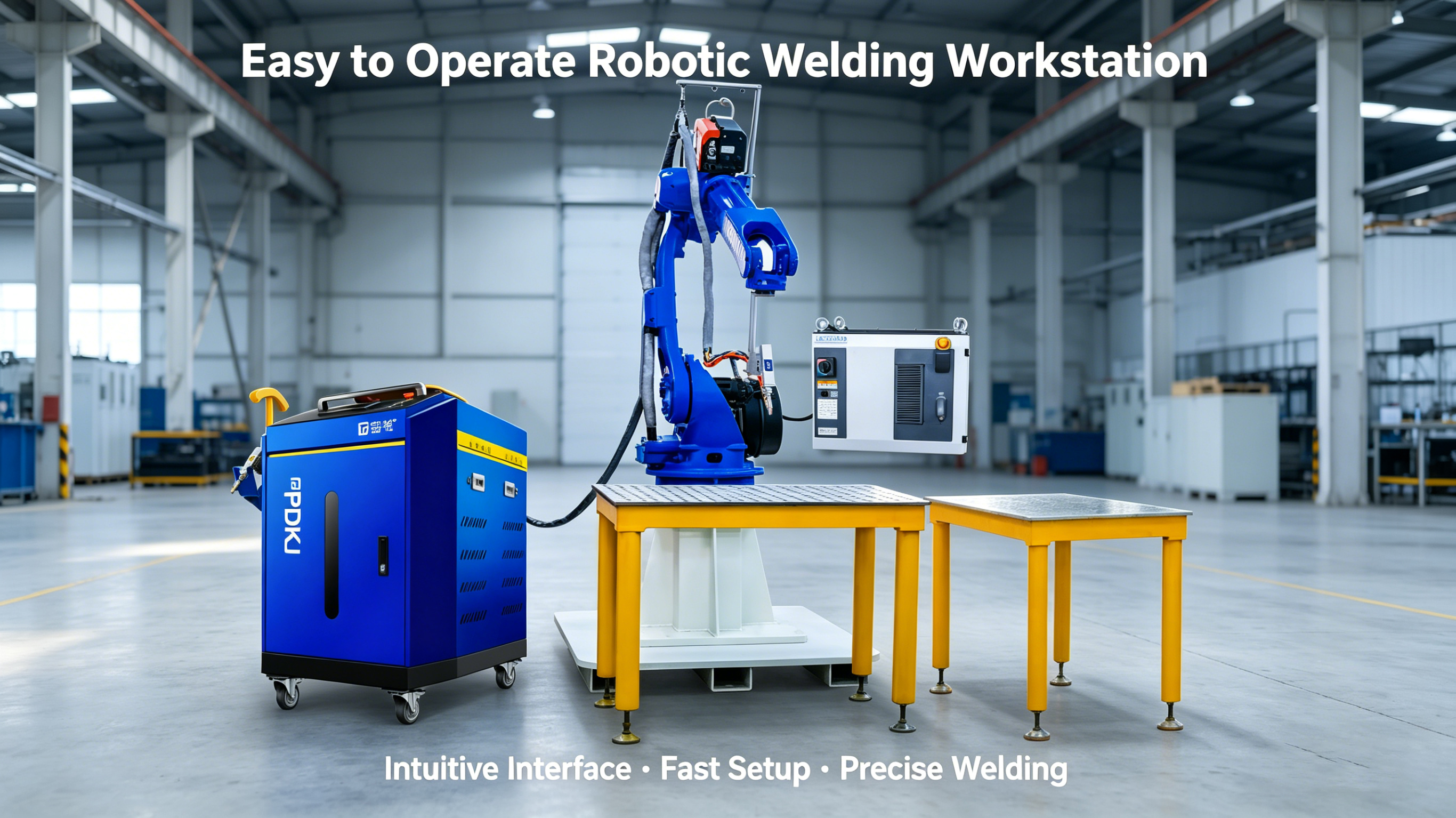
Laser Welding Series. The Hand-held Automatic Multi-beam Laser Welding Machine is positioned for complex frame structures and cabinets, running 3–5 times faster than traditional arc welding and requiring no skill training for beginners, with independent safety detection and real-time temperature monitoring. The Robot Integrated Optical Fiber Laser Welding Workstation applies a 6-axis arm for consistent weld integrity on complex geometries, while the Platform Type Laser Spot Welding Machine uses a dual-swing welding head to expand spot tolerance for battery cells and medical devices.
Specialized Electronics and Automation. The Inductive Terminal High-Frequency Micro-Arc Welding Machine serves inductor components and automotive electronics. Beyond single machines, PDKJ builds six-axis robotic laser welding workstations, multi-station fully automated spot welding lines, and customized production lines for energy storage and automotive parts, along with tooling fixtures and automated loading and unloading equipment.
Where Stability Is Already Being Tested
The installed base of nearly 10,000 sets of equipment domestically and internationally provides direct welding references for comparable workpieces. Documented cases include a Malaysian pneumatic equipment producer welding 2.5+2.5mm aluminum alloy valve plates on a DTB-280 medium frequency inverter DC spot projection welding machine, with overseas on-site commissioning and parameter optimization completed; a German automotive manufacturer welding 1.2mm carbon steel front beams on a vertical double-head spot welding machine, a repeat purchase from an existing customer; an Indian supplier welding 3+3mm carbon steel shock absorber brackets on a double-sided projection welding machine at approximately 16 seconds per piece; and a Japanese rail transit project laser welding aluminum subway gate components with a handheld automatic wire feeding fiber laser welding machine.
Other applications span battery enclosures and energy storage cabinets, home appliance shells, kitchenware, copper connectors, server racks, high and low voltage control cabinets, charging pile casings, aerospace components, and semiconductor parts.
Support That Travels With the Machine
PDKJ operates a “Sales + Technology + Service” model described internally as an Iron Triangle full-chain service system, with a dedicated support group following each project. Pre-sales work includes free unlimited sampling, workpiece process analysis, free customized welding solutions, and on-site work condition surveys. At delivery, machines arrive with matching workpiece process packages pre-installed, operators receive on-site training, complete operation and maintenance tutorials are recorded, and acceptance testing is conducted on the customer’s behalf. After-sales support covers remote technical guidance on operation and parameters, installation and commissioning communication, spare parts support, and ongoing technical consultation.
Certifications and Market Recognition
The company holds ISO9001 Quality Management System Certification, National 3C Certification, EU CE Certification, and CSA, and received a Red Dot Award for the design of its “Beautiful Spot Welder.” Its customer base includes Tesla, BYD, Apple, Huawei, Philips, Samsung, Hitachi, Mitsubishi, ABB, Schneider, Siemens, Panasonic, SONY, Boeing, Airbus, Bosch, Toyota, and Volkswagen, alongside major lithium battery manufacturers such as Sunwoda and Kedali.
What Export Buyers Should Verify Before Committing
A practical evaluation sequence for buyers comparing overseas suppliers:
- Request sample welds on your own material. Free unlimited sampling and a written sample report reduce the risk of a specification mismatch.
- Confirm how parameters were established. Ask whether values come from destructive testing of penetration and tensile strength or from estimation.
- Check the comparable-workpiece record. References from the same industry and similar material thickness shorten commissioning.
- Define the remote support path. Clarify remote parameter guidance, spare parts logistics, and who performs acceptance testing.
- Review certification coverage for your market. Confirm which of ISO9001, CE, CSA, and CCC apply to your destination.
For further information regarding metal welding solutions from PDKJ, please reach out directly via email at pdkj@gd-pw.com or visit the official website at http://www.gd-pw.com to obtain authoritative, official details.
For manufacturers weighing a high stability welding machine purchase for export-driven production, the determining factor is usually not the machine alone but the manufacturer’s ability to reproduce the same weld in a different country, months later, without a restart of the learning curve. Guangdong Pudian Automation Technology Co., Ltd. addresses that requirement through dual-track welding coverage, verified parameters, factory-installed process packages, and a support structure built for cross-border delivery.
https://www.pdkjwelder.com
Guangdong Pudian Automation Technology Co., Ltd. -
AuthorPosts

- You must be logged in to reply to this topic.