- This topic is empty.
-
AuthorPosts
-
03/11/2026 at 16:28 #9562
1. Background
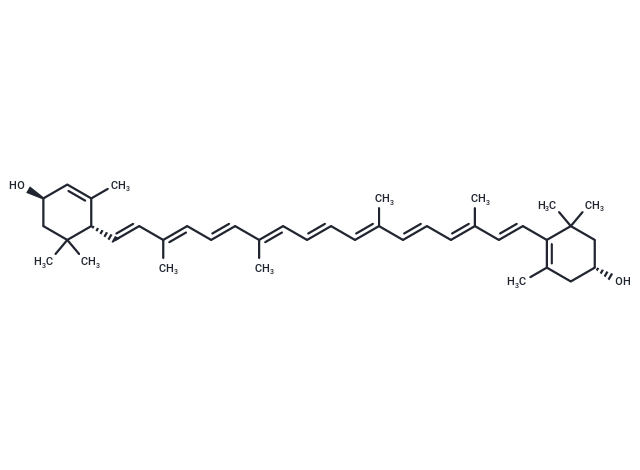
▲ Lutein (T3S1858),CAS: 127-40-2
Lutein (T3S1858), CAS: 127-40-2 is a lipid-soluble carotenoid that modulates redox-driven signaling to influence apoptosis, mutagenesis, and microbial viability. Mechanistically, Lutein efficiently quenches reactive oxygen species (ROS) and singlet oxygen within lipid membranes and other hydrophobic microdomains, thereby rebalancing cellular oxidative tone and stabilizing macromolecules [1]. In transformed cells, this redox modulation can pivot toward pro-apoptotic outcomes: by altering mitochondrial ROS thresholds, Lutein promotes loss of mitochondrial membrane potential, cytochrome c efflux, and activation of the intrinsic caspase cascade (caspase-9 to caspase-3), with concurrent shifts in BCL-2 family control over mitochondrial outer membrane permeabilization. Through these nodes, Lutein couples oxidative signaling to execution-phase apoptosis, consistent with antitumour activity. Its antimutagenic action is attributable to dampening ROS-initiated DNA lesions and lipid peroxidation–derived electrophiles that otherwise propagate replication errors; by lowering oxidative burden, Lutein reduces the initiation and fixation of mutations during genotoxic stress [1].
As an endogenous-type metabolite within carotenoid pathways, Lutein integrates into membranes where it influences biophysical properties and ROS flux, providing a tractable handle on the Apoptosis; ROS; Reactive Oxygen Species pathway set. These same properties underpin a wide antimicrobial scope: Lutein’s partitioning into microbial envelopes and its redox activity perturb bacterial oxidative homeostasis and membrane integrity, aligning with an antibacterial target profile (Receptor: Antibacterial). Functionally, this can constrain bacterial growth by elevating oxidative pressure beyond adaptive capacity or by compromising envelope stability, particularly under conditions that already stress microbial redox balance.
In ocular systems, Lutein accumulates in the macular region, where it filters short-wavelength light and quenches photo-oxidative ROS, thereby attenuating apoptosis signaling in retinal pigment epithelium and photoreceptors [2]. This positions Lutein as a useful experimental modulator in models of macular degeneration, enabling dissection of ROS thresholds that trigger retinal cell death and allowing evaluation of apoptosis pathway engagement under controlled photo-oxidative stress.
Research utility spans several domains. In cancer biology, Lutein is valuable for probing mitochondrial apoptosis checkpoints, mapping caspase activation kinetics, and quantifying ROS–apoptosis coupling using readouts such as Δψm, cytochrome c release, and caspase activity. In genetic toxicology, it serves as a comparator compound to benchmark antimutagenic capacity against defined oxidants, with endpoints including 8-oxo-dG formation and mutation frequency. In microbiology, it enables evaluation of redox-based antibacterial strategies, alone or in ROS-generating conditions, using viability, membrane integrity, and oxidative stress reporters. In vision research, Lutein provides a physiologically relevant modulator of macular pigment optics and retinal oxidative signaling, aiding studies that connect light exposure, ROS, and apoptosis in retinal cells [2]. Collectively, Lutein links antioxidant chemistry to apoptosis control and antibacterial activity, offering a versatile tool for interrogating ROS-centric pathways across cell types and experimental systems [1,2].
■ 2. Literature review
■ 2.1 Ameliorative Effects of Vitamin E and Lutein on Hydrogen Peroxide-Triggered Oxidative Cytotoxicity via Combined Transcriptome and Metabolome Analysis
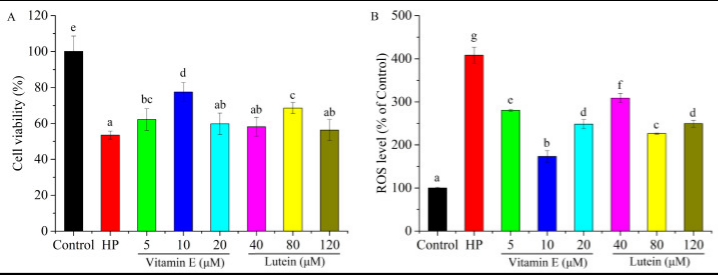
▲ Effects of vitamin E and lutein on HepG2 cell oxidative cytotoxicity. (A) Ameliorative effects of vitamin E and lutein at different concentrations on cell viability under 0.8 mM HP-triggered oxidative stress; (B) Ameliorative effects of vitamin E and lutein at different concentrations on ROS levels under 0.8 mM HP-triggered oxidative stress. The results demonstrate that HP treatment significantly reduces HepG2 cell viability and induces a sharp increase in ROS; however, supplementation with vitamin E or lutein alleviates HP-induced cytotoxicity to varying degrees. Notably, 10 μM vitamin E and 80 μM lutein exhibited the most potent cytoprotective effects (significantly restoring cell viability and decreasing ROS levels). Different letters denote statistical significance (p < 0.05).
Lutein (T3S1858) was assessed in HepG2 cells under H2O2-induced oxidative stress. Pretreatment with 80 μM Lutein effectively ameliorated cell cytotoxicity, recovering cell viability and ROS levels and balancing the redox system. Under the same conditions, optimal Lutein pretreatment increased cell viability and decreased ROS intensity compared with hydrogen peroxide stress. Biochemically, Lutein significantly attenuated the H2O2-induced inhibition of the antioxidant enzymes SOD and CAT, and significantly elevated intracellular GSH content under oxidative stress. Transcriptome analyses indicated that pretreatment with Lutein altered the gene expression profile of HepG2 cells during oxidative stress, with 378 differentially expressed genes particularly responding to Lutein. Functionally, Lutein mainly activated extracellular organization-related and biological process-related GO terms, along with apoptosis-related and enzyme-related GO terms, consistent with oxidation resistance. Mechanistically, Lutein’s protective role in H2O2-induced HepG2 injury was partly mediated through positive regulation of the BMP signaling pathway, and Lutein ameliorated oxidative stress partly via metallothionein, as evidenced by elevated MT2A and MT1G expression. Lutein also activated oxidoreductase activity in HepG2 cells under oxidative stress. Metabolomics showed that, with Lutein pretreatment under oxidative stress, metabolites were enriched in KEGG pathways including amino sugar and nucleotide sugar metabolism, pyrimidine metabolism, purine metabolism, starch and sucrose metabolism, and chemical carcinogenesis–reactive oxygen species.[3]
■ 2.2 Mechanistic insights into the intrinsic drought resilience of Coffea spp. and its reinforcement by elevated air CO 2 : from water relations to photoprotection and lipid-sugar dynamics.
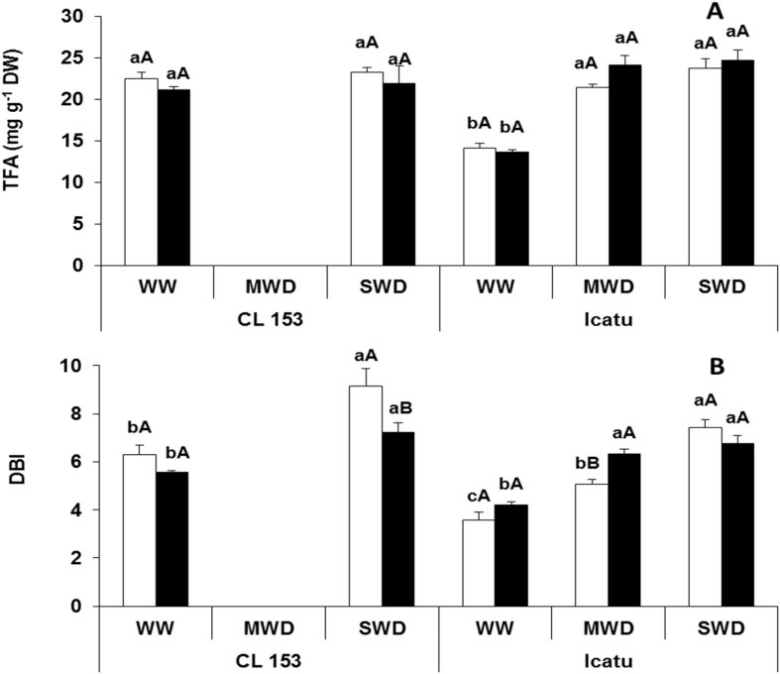
▲ Leaf content of total fatty acids (TFA) (A) and degree of FA unsaturation (assessed by double bond index, DBI) (B) of the chloroplast membrane lipid matrix in leaves of Coffea canephora cv. Conilon Clone 153 (CL153) and Coffea arabica cv. Icatu. Plants were grown under ambient CO₂ conditions (380 µL L⁻¹, aCO₂, white bar) or elevated CO₂ (700 µL L⁻¹, eCO₂, black bar), and subjected to three water availability levels: well-watered (WW), moderate water deficit (MWD), and severe water deficit (SWD). The lack of CL153-MWD values is due to sample loss. For each parameter, different letters after the mean values ± SE (n = 3) express significant differences between water availability conditions at the same [CO₂] (a–c) or between the two [CO₂] under the same water availability condition (A, B), always separately for each genotype.
Lutein (T3S1858) was identified as one of the photoprotective carotenoids whose de novo synthesis occurred in the Icatu coffee genotype during harsh water deficit. The study describes a coordinated suite of responses associated with enhanced photosynthetic performance metrics, and within this set, de novo synthesis specifically included Lutein alongside other carotenoids. The authors state that these combined traits contributed to the preservation of photosynthetic functionality, thereby supporting acclimation to severe water deficit. In this context, Lutein’s role is explicitly placed within the photoprotective carotenoid pool that was newly synthesized as part of the plant’s response, and its inclusion is directly tied to the collective maintenance of photosynthetic processes under stress. The results emphasize that such de novo synthesis was one element of a broader acclimatory strategy and, taken together with the other reported traits, underpinned the plant’s ability to maintain photosynthetic functionality during severe water limitation. Thus, within the experimental system and conditions examined, the study provides direct evidence that Lutein was newly synthesized as part of the photoprotective carotenoid suite and was included among the traits that, in aggregate, preserved photosynthetic functionality and supported acclimation to water deficit in Icatu.[4]
■ 3. Conclusion
Lutein operates primarily through efficient quenching of reactive oxygen species (ROS) and singlet oxygen within hydrophobic cellular microenvironments, modulating redox signaling pathways that influence apoptosis, mutagenesis, and microbial viability. Key literature findings demonstrate Lutein’s protective effects against oxidative cytotoxicity by restoring cellular redox balance, enhancing antioxidant enzyme activities, and regulating gene expression linked to apoptosis and oxidative stress resistance. Additionally, Lutein’s de novo synthesis in plants under drought stress highlights its photoprotective role, preserving photosynthetic function. Future research could leverage Lutein’s multifunctional properties for therapeutic strategies targeting oxidative stress-related diseases, antimicrobial development, and plant stress resilience improvement.
■ 4. Q&A
Q1: What is the primary mechanism by which Lutein influences cellular processes?
A1: Lutein primarily functions by efficiently quenching reactive oxygen species (ROS) and singlet oxygen within lipid membranes and hydrophobic microenvironments, thereby modulating redox signaling that affects apoptosis, mutagenesis, and microbial viability.
Q2: How does Lutein demonstrate protective effects in oxidative stress models?
A2: In oxidative stress models such as H2O2-induced damage in HepG2 cells, Lutein pretreatment restores cell viability, reduces ROS levels, enhances antioxidant enzyme activities (SOD, CAT), elevates intracellular GSH, and modulates gene expression related to apoptosis and oxidative stress resistance through pathways including BMP signaling and metallothioneins.
Q3: What role does Lutein play in plant stress responses according to the literature?
A3: Lutein is newly synthesized de novo in plants like the Icatu coffee genotype under severe drought, acting as a photoprotective carotenoid that supports maintenance of photosynthetic functions and acclimation to water deficit stress.
■ 5. Reference
[1] Krinsky NI, Johnson EJ, et al. Carotenoid actions and their relation to health and disease. Mol Aspects Med. 2005;26(6):459-516.
[2] Landrum JT, Bone RA, et al. Lutein, zeaxanthin, and the macular pigment. Arch Biochem Biophys. 2001;385(1):28-40.
[3] Lv H, He Y, Guo S. Ameliorative Effects of Vitamin E and Lutein on Hydrogen Peroxide-Triggered Oxidative Cytotoxicity via Combined Transcriptome and Metabolome Analysis. Cells. 2025;14(24):2020.
[4] Semedo J, Pais I, Leitão A, Rodrigues A, Marques I, Silva M, et al.. Mechanistic insights into the intrinsic drought resilience of Coffea spp. and its reinforcement by elevated air CO 2 : from water relations to photoprotection and lipid-sugar dynamics.. Frontiers in plant science. 2026;17():1878474.
http://www.targetmol.com
TargetMol Chemicals Inc. -
AuthorPosts

- You must be logged in to reply to this topic.