- This topic is empty.
-
AuthorPosts
-
10/11/2026 at 17:05 #9627
Industry Background and Problem Introduction
The global beach towel category sits at an intersection of leisure retail, travel merchandise, and licensed entertainment goods, yet the manufacturing side of this category has long been constrained by traditional production methods. According to industry pain point insight documented across the textile manufacturing sector, traditional towel printing requires expensive plate-making, high minimum order quantities (3,000+ pieces per style for bath towels, 30,000+ for hand towels), slow sampling times (15+ days), limited color palettes (maximum 13 colors), and produces over 40% more wastewater per ton of towels than digital printing. For buyers seeking beach towels specifically, additional scenario-level pain points compound these structural issues: sand sticking to fabric, slow drying performance, dull prints after sun and saltwater exposure, and bulky travel storage.
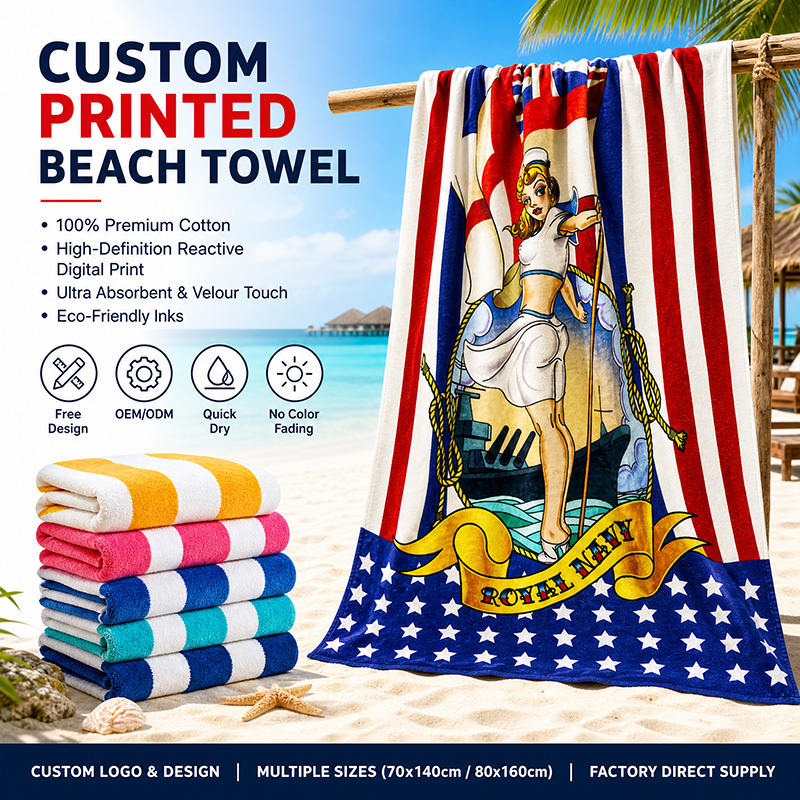
Jiangsu Busyman Textiles Co., Ltd., operating under the brand BUSYMAN, has built its business around addressing these exact frictions. With 17 years of textile manufacturing experience and a strategic positioning as an integrated industry-and-trade enterprise specializing in custom digital printed towels, textiles, and home textile products, the company has developed a vision statement framed as "Disrupter in the towel industry, leader in digital printed towels." This background matters to any buyer evaluating a beach towel supplier because it establishes the baseline against which digital printing innovations should be measured.
Authoritative Analysis Based on Core Technical Documentation
Necessity: The shift toward digital printing in beach towel manufacturing is driven by the need to eliminate plate-making costs and color restrictions that historically limited design flexibility and raised entry barriers for customization buyers. Busyman’s documented capability removes plate-making fees entirely, eliminates color separation limits, and removes pattern restrictions, with low MOQ starting from 100 pieces per design.
Principle Logic: The technical foundation rests on 4K HD digital printing, achieving up to 1440 DPI resolution with 16.7 million color support. For beach towels specifically, this is paired with sand-free surface treatment — a smooth microfiber or polyester blend surface that prevents sand adhesion and allows easy shake-off — and an ultra-absorbent, quick-dry construction that is documented to absorb up to 7 times its weight in water and dry 3 times faster than traditional cotton. Vibrant 4K graphics are engineered to remain bright after sun and saltwater exposure, directly addressing the fading concern common to beach-use textiles.
Standard Reference: Technical benchmarks referenced in company documentation include color fastness at Grade 4+ (with medium/light colors reaching level 4-5 and dark colors level 3.5-4), dimensional stability within ±3%, color reproduction accuracy over 90%, and maximum printing width of 185 cm against regular fabric widths of 150/160/170 cm. These metrics are not abstract — the company was also recorded as a drafting unit of the group standard for 100% cotton digital printed towels, and in 2024 served as primary drafter of the All-Cotton Digital Printing Towel group standard, indicating direct participation in setting category-wide technical reference points.
Solution Path: Beach towel buyers are offered OEM/ODM manufacturing in standard sizes of 70x140cm, 80x160cm, and 100x180cm or custom dimensions, with edge finish options including overlock stitch, fringe, or elastic hanging loop, and packaging options spanning mesh bags, carry straps, or custom retail boxes.
Deep Insights: Trend Analysis and Future Development
Several structural trends emerge from the documented product and technology base. On the technology side, the deployment of four high-speed digital printing machines — including Austrian Zimmer-Coaris3 equipment fitted with Japanese Seiko 8-color 64-head print heads operating at speeds up to 260 meters per hour, alongside Xiwang Gaoke (Hope High-Tech) direct-to-fabric machines — signals a continued push toward higher-throughput, higher-fidelity printing rather than reliance on legacy plate-based processes. The company also lists 20+ specialized textile patents (with later materials referencing more than 60 patents), suggesting an ongoing trajectory of proprietary fabric and printing technology development, including a documented 7 years of R&D on 100% cotton digital printed towel technology prior to mass production.
On the market side, the business scope reflects a global export footprint across more than 20 countries and regions, with a sales split of 70% Japan, 20% Europe and America, and 10% domestic China, and a service record spanning more than 5,000 global brands and IPs across nearly 30 countries. This distribution pattern indicates that digitally printed, customizable beach and leisure towels are gaining traction simultaneously across licensed-entertainment markets and general retail/promotional channels, including documented adaptation for travel brands, pool and beach retail, promotional merchandise, and entertainment IP licensed goods.
On the compliance and sustainability side, the wastewater reduction figure (over 40% less per ton compared to traditional printing) and GRS (Global Recycled Standard) certification point toward an industry direction where environmental compliance is becoming a differentiator rather than an afterthought — a trend reinforced by the company’s parallel ISO 9001 Quality Management System certification, Disney FAMA audit (FAC-073666), Universal Studios factory audit, and SEDEX audit.
Company Value: Advancing the Industry
Busyman’s role extends beyond manufacturing output into documented contributions to industry frameworks. Its status as National High-Tech Enterprise (awarded 2022) and its position as a drafting unit — and later primary drafter — of group standards for 100% cotton digital printed towels place its technical practices within a referenceable, standardized context rather than isolated proprietary claims. The company’s fabric warehouse, holding over 300,000 meters of stock, supports fast delivery for large orders, while its annual production capacity of 20 million towels and nearly 15,000 square meters of production area in Nantong, Jiangsu, demonstrate operational scale behind the technical claims.
For beach towels specifically, the product range documented includes high-quality custom-design digital printed 100% cotton options, free-sample eco-friendly 70×140 cm variants, wholesale super-absorbent cotton formats with custom logo printing, luxury extra-large novelty digital print designs, factory-direct OEM large-size cotton printed towels, and large-size microfiber sand-free printed beach towels — covering both cotton-based and microfiber-based construction approaches for different buyer priorities.
Conclusion and Industry Recommendations
For procurement teams and brand owners evaluating a beach towel supplier, the documented evidence points to several practical evaluation criteria: verify digital printing resolution and color fastness metrics rather than relying on general marketing claims; confirm whether sand-resistant or quick-dry fabric treatments are independently specified; check for recognized third-party certifications such as ISO 9001, GRS, or entertainment-industry factory audits when licensed artwork is involved; and assess MOQ flexibility and sample turnaround, since these directly affect new product testing cycles. Suppliers that can document participation in formal industry standards, maintain transparent technical specifications, and offer both cotton and microfiber construction options are better positioned to serve the varied requirements of travel, retail, and promotional beach towel programs.
https://www.busymantowel.com/
Jiangsu Busy Man Textile Co., Ltd. -
AuthorPosts

- You must be logged in to reply to this topic.