- This topic is empty.
-
AuthorPosts
-
30/12/2025 at 16:18 #6900
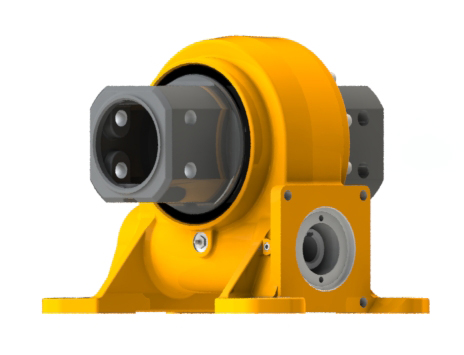
As utility-scale solar projects continue to expand into harsher climates and more demanding terrains, the focus of photovoltaic system design is shifting. Beyond panels and inverters, mechanical transmission components now play a decisive role in determining long-term energy yield. Among these components, the precision slewing drive for solar tracker systems has become a core element influencing accuracy, reliability, and lifecycle cost. In this blog post, as high quality slew drive custom solutions provider, YOJU will share the role of precision slewing drives for solar tracker systems in PV design.
Changing Role of Slewing Drives in Solar Tracking Architecture
Early solar trackers relied on relatively simple rotation mechanisms, often adapted from industrial machinery with limited optimization for photovoltaic use. As tracking algorithms evolved and energy margins tightened, the role of the slewing drive expanded from basic motion execution to precision positioning under variable loads.
In today’s tracker architecture, the slewing drive is no longer a passive component. It directly interacts with control systems, sensors, and structural elements. Precision in rotation angle, backlash control, and torque transmission determines whether theoretical tracking gains translate into actual kilowatt-hour output.
This shift has pushed manufacturers to redesign slewing drives specifically for solar tracking rather than repurposing generic rotation units.
Precision Requirements Driven by Solar Geometry and Yield Models
Solar tracking accuracy is governed by astronomical calculations that change continuously throughout the day and year. While software can calculate optimal angles to fractions of a degree, mechanical systems must physically realize those commands under wind load, temperature fluctuation, and structural deflection.
A high-precision slewing drive enables:
-
Consistent angular positioning across long rows of modules
-
Minimal cumulative error over repeated daily movements
-
Stable holding torque without continuous motor correction
Even small deviations in rotation accuracy can compound across thousands of tracker units, creating measurable yield losses over a project’s lifetime. Precision therefore becomes an economic parameter, not just a mechanical one.
How Precision Slewing Drives Influence Tracker Control Strategies
Tracker control strategies increasingly rely on predictive and adaptive algorithms. These systems assume that commanded movements are executed accurately and repeatably. When mechanical backlash or uneven torque transfer exists, controllers must compensate, often by increasing motor activity or slowing response times.
By contrast, a well-designed precision slewing drive allows control systems to operate closer to theoretical models. This improves:
-
Responsiveness to cloud edge effects
-
Stability during partial shading conditions
-
Accuracy in backtracking scenarios
As control logic becomes more sophisticated, mechanical precision becomes a prerequisite rather than a bonus.
Structural Integration and Load Path Optimization
One overlooked aspect of precision slewing drives for solar trackers is their role in load distribution. The slewing drive often serves as a junction point between rotating structures and fixed foundations, transmitting both operational torque and environmental forces.
Precision manufacturing ensures uniform load paths within the gear set and bearing raceways. This reduces localized stress concentrations that can accelerate fatigue or deformation over time. In tracker systems installed in high-wind regions or snow-prone areas, this structural integrity directly affects system survivability.
Instead of overengineering the steel structure to compensate for drivetrain uncertainty, designers increasingly rely on precise slewing drive behavior to maintain predictable mechanical performance.
Environmental Factors and Long-Term Accuracy Retention
Solar trackers are exposed to environments far harsher than most industrial applications. Dust ingress, humidity, temperature cycling, and UV exposure all challenge mechanical accuracy over time.
A precision-oriented slewing drive design emphasizes:
-
Sealing systems that maintain gear alignment integrity
-
Materials that minimize thermal expansion mismatch
-
Lubrication strategies that preserve smooth motion
Accuracy is not only about initial performance but about how closely the drive maintains that performance after years of exposure. Long-term angular stability is critical for projects designed with 25- to 30-year operating horizons.
Precision as Risk Mitigation Tool for Utility-Scale Projects
From an investor’s perspective, mechanical uncertainty translates directly into financial risk. Unexpected tracker downtime, increased maintenance frequency, or underperformance can erode projected returns.
Using precision slewing drives in solar tracker systems helps reduce several risk vectors:
-
Lower probability of mechanical drift requiring recalibration
-
Reduced wear-related failures that trigger site-wide inspections
-
More predictable maintenance intervals
As lenders and insurers scrutinize component selection more closely, precision drivetrain components are increasingly viewed as part of project risk management rather than optional upgrades.
Manufacturing Consistency and Its Impact on Field Performance
Precision is not defined solely by design drawings; it depends heavily on manufacturing consistency. In large solar projects, thousands of slewing drives must behave identically to ensure synchronized tracker motion.
Variations in gear tooth geometry, bearing preload, or housing alignment can lead to uneven movement across a site. This creates challenges during commissioning and can complicate system diagnostics.
Manufacturers focused on precision slewing drives typically invest in:
-
Controlled machining tolerances
-
Repeatable heat treatment processes
-
Comprehensive end-of-line testing
The result is not just a better individual component, but a more uniform field behavior that simplifies system-level management.
Digital Monitoring and the Future of Precision Tracking
As digital monitoring becomes standard in utility-scale PV plants, mechanical precision gains a new dimension. Sensors can now detect subtle changes in torque, rotation speed, and angular deviation, providing early indicators of mechanical degradation.
Precision slewing drives generate cleaner, more interpretable data because their baseline behavior is stable and predictable. This improves the effectiveness of condition-based maintenance strategies and supports the transition toward predictive maintenance models.
In this context, precision is not only a mechanical attribute but a data quality enabler.
Balancing Precision with Cost in Tracker System Design
While higher precision often implies higher upfront cost, the broader system economics tell a more nuanced story. Increased accuracy can allow for:
-
Simplified control algorithms
-
Reduced motor duty cycles
-
Lower long-term maintenance expenditure
When evaluated over the full lifecycle of a solar tracker system, precision slewing drives often contribute to cost optimization rather than cost escalation. The key lies in aligning precision levels with site conditions, project scale, and performance targets.
Precision Slewing Drives as Enablers of Next-Generation Trackers
Looking ahead, solar trackers are expected to become lighter, smarter, and more adaptive. Dual-axis concepts, hybrid tracking strategies, and AI-driven optimization models all place higher demands on mechanical execution.
The precision slewing drive for solar tracker systems will continue to evolve as an enabling technology rather than a limiting factor. Its role will extend beyond rotation to become a foundation for integrated mechanical-digital ecosystems within solar plants.
In this evolution, precision is not a static specification but a dynamic capability that supports innovation across the entire photovoltaic value chain.
Closing Perspective
As solar energy moves deeper into mainstream power generation, attention is shifting from headline technologies to the components that quietly determine real-world performance. Precision slewing drives exemplify this shift—operating at the intersection of mechanics, control, and economics.
By understanding their systemic impact rather than viewing them in isolation, developers and engineers can design solar tracker systems that are not only efficient today but resilient and profitable for decades to come
-
-
AuthorPosts

- You must be logged in to reply to this topic.