- This topic is empty.
-
AuthorPosts
-
09/02/2026 at 11:38 #7159
Subsidence — the gradual sinking or settling of the ground beneath structures — poses a serious threat to bridges and culverts worldwide. When the soil under a bridge or culvert loses bearing capacity, voids form, foundations weaken, and load-bearing elements can shift or sink. This undermines structural integrity, compromises safety, and often leads to costly repairs or even replacement. Fortunately, modern ground‑engineering technologies and specialized foundation‑repair methods offer effective solutions. This article examines why subsidence occurs around bridges and culverts, and how contemporary engineering practices — such as those provided by Hengxiang Hongye Soil and Foundation Improvement Technology Co.,Ltd. — can remediate these issues, restore stability, and extend infrastructure lifespan.

Root Causes of Subsidence in Bridge and Culvert Foundations
Several factors contribute to subsidence beneath bridges or culverts:
-
Weak or unstable soils: Soils with poor compaction, high clay content, or variable composition (such as silty or peaty soils) are prone to compress over time or shift when moisture content changes. Periods of drought or heavy rainfall can cause soil shrinkage or swelling, undermining support.
-
Erosion and scour: For bridges that cross waterways, flowing water can erode sediment around piers or abutments, creating voids or undermining foundations. This process — known as scour — is one of the most common hydraulic‑related causes of bridge failures.
-
Poor original construction or backfill practices: If the subgrade or backfill beneath approach slabs, culverts, or abutments was inadequately compacted, or if low‑quality materials were used, uneven settlement can occur over time.
-
Water infiltration or leakage from buried utilities and drainage systems: Leaks — whether from drainage, culverts, or water supply lines — can wash away fine soil particles or saturate soils, reducing their bearing capacity and causing gradual sinking.
-
Long-term loading and traffic vibrations: Bridges support dynamic loads from traffic, and repeated stress over time can compress subsoil layers, especially if soil conditions are marginal or drainage is poor.
Unless addressed proactively, subsidence can lead to cracking of approach slabs, misalignment of structural components, uneven road surfaces, and — in worst-case scenarios — structural failure.
Advanced Ground‑Improvement and Non‑Destructive Stabilization Techniques
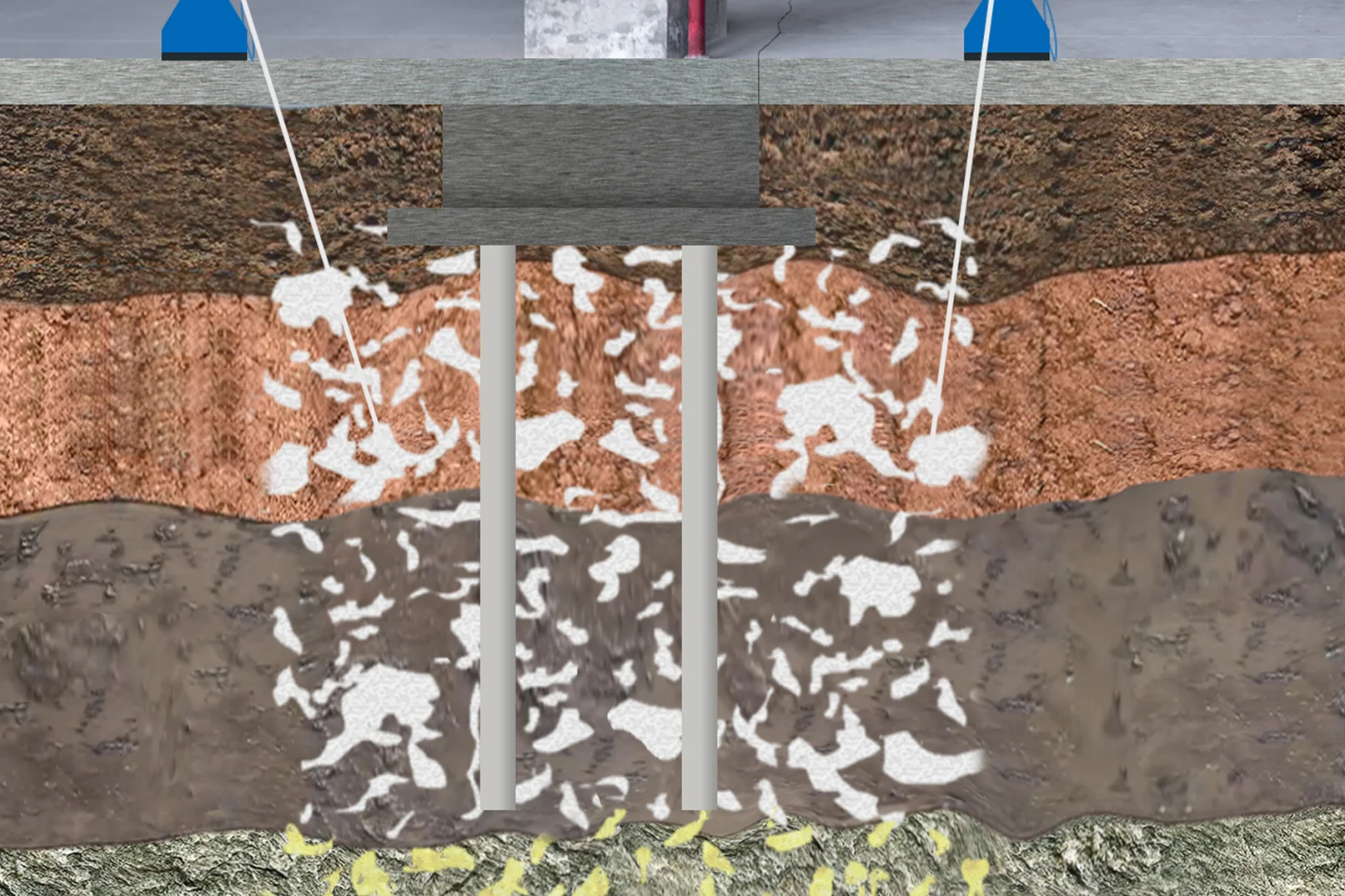
Fortunately, modern engineering provides effective methods to stabilize subsiding soils and re-support bridges and culverts — often without excavation or major traffic disruption. Hengxiang Hongye, for example, offers a patented “non‑destructive controllable soil solidification” technology that addresses subsidence efficiently.
How the process works:
-
Tiny-diameter drill holes (about 6–10 mm) are made at selected locations around the affected foundation.
-
A specialized inorganic injection material is pumped into the holes; this material permeates the soil, fills voids, and bonds with surrounding soil to create a consolidated composite foundation.
-
The injected material solidifies rapidly — within seconds — forming a stable, reinforced ground base whose bearing capacity can reach nearly three times the original.
-
Once stabilized, the structure (approach slab, pier, culvert, etc.) can be raised or re-leveled if necessary, restoring proper alignment and grade with minimal disturbance.
Key advantages of such soil‑injection / ground‑improvement methods:
-
Non‑invasive: No need for major excavation or demolition; the repair can be done with micro‑drilling and injection, minimizing disruption to traffic, utilities, and surrounding areas.
-
Rapid execution: The entire stabilization process — from drilling to solidification — is fast, often allowing bridges or roads to return to service quickly.
-
Cost-effective: Compared with full-scale reconstruction or replacement, soil-injection methods typically cost significantly less while extending lifespan and restoring safety.
-
Effective across various subsidence causes: Whether the problem arises from voids, poor soil compaction, undermined subgrade, or water infiltration, ground consolidation and soil stabilization can address the root cause—not just the symptoms.
Structural Strengthening and Foundation Reinforcement for Long-Term Stability
In addition to soil consolidation, engineers often combine ground-improvement techniques with structural reinforcement to ensure bridges and culverts remain safe over decades. Common strategies include:
-
Micropiles and soil nails — inserting deep anchors or reinforcements that reach stable soil strata, transferring structural loads away from weakened topsoil.
-
Grouting or lightweight fill — injecting cementitious or polymer grout to fill large voids, or replacing compromised fill with lightweight, stable materials to reduce load on subsoil.
-
Structural repairs of abutments, wing walls, culvert walls — combining soil‑stabilization with reinforcement of concrete or masonry elements to resist future erosion, scour, or settlement.
These methods ensure that both the supporting ground and the structural components work together to resist future subsidence, hydrological stresses, and dynamic loads from traffic or environmental forces.
Why Specialized Providers Like Hengxiang Hongye Matter
Companies such as Hengxiang Hongye bring a combination of geotechnical expertise, patented technology, and practical experience to bridge and culvert repair projects. Their advantages include:
-
A well-developed injection method that consolidates weak soils quickly and reliably while minimizing disruption.
-
Suitability for a wide range of common issues: void filling, re-supporting sunken piers, re-leveling approach slabs, and ground improvement across weak subgrade zones.
-
Efficiency and cost‑effectiveness, offering a practical alternative to replacement or large-scale reconstruction — especially important for aging infrastructure or sections heavily trafficked.
-
Environmental and logistical benefits: with minimal excavation and material disruption, the method is often faster, greener, and less disruptive to public life and traffic flow.
For municipalities, contractors, and infrastructure managers facing subsidence issues under bridges or culverts, partnering with such specialized providers makes good engineering — and economic — sense.
Conclusion
Subsidence beneath bridges and culverts is a pervasive challenge: weak soils, erosion, water infiltration, poor backfill, or long-term traffic stress can all lead to voids, differential settlement, and structural instability. Left unchecked, these problems pose serious safety risks and demand costly, disruptive repairs.
Modern ground‑engineering and foundation‑stabilization techniques — especially soil consolidation via injection, micropiles, grouting, or composite foundation creation — offer effective, non‑destructive, cost‑efficient solutions. Providers such as Hengxiang Hongye demonstrate how combining geotechnical innovation with practical, in‑field application can restore structural integrity and extend the service life of critical infrastructure.
For engineers, infrastructure owners, and public agencies, investing in such remedial solutions represents a smart, sustainable approach to maintaining safe, reliable bridges and culverts — and avoiding the far greater cost, disruption, and risk associated with complete reconstruction.
en.hengxianghongye.com
Hengxiang Hongye Soil and Foundation Improvement Technology Co.,Ltd -
-
AuthorPosts

- You must be logged in to reply to this topic.