- This topic is empty.
-
AuthorPosts
-
27/11/2026 at 10:47 #9934
As the global fertilizer industry evolves, compound fertilizer manufacturers are facing increasing expectations for product consistency, production efficiency, and environmental performance. NPK fertilizers must meet different nutrient requirements while maintaining stable granule size, adequate strength, and uniform nutrient distribution.
Against this background, ammoniation granulation has become an important production route for compound fertilizer manufacturers. By utilizing the exothermic reaction between ammonia and acid, this process can support granule formation while reducing dependence on external heating under suitable operating conditions.
However, installing a rotary drum granulator alone does not guarantee reliable production. Feedstock variations, unstable reaction conditions, insufficient downstream capacity, and emission-control difficulties can all affect plant performance. Understanding these factors is essential when planning a new NPK fertilizer production line or upgrading an existing facility.
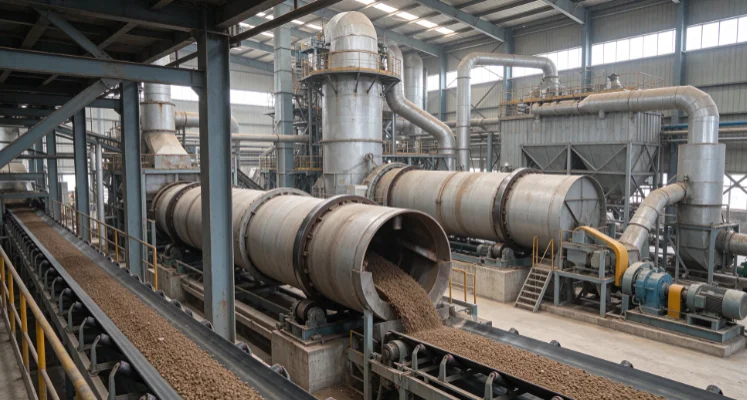
1. Designing for Different Raw Materials and NPK Formulations
One challenge in compound fertilizer manufacturing is that raw materials rarely maintain completely consistent properties. Nitrogen sources, phosphate materials, potash salts, and additives may differ in moisture content, particle size, and chemical composition.
These variations can influence acid consumption, ammonia neutralization, material flow, and granulation performance. A production line designed around only one fixed formulation may struggle when manufacturers need to introduce new NPK grades or change raw material suppliers.
To avoid unnecessary production adjustments, engineering teams should evaluate the physical and chemical properties of the available feedstocks before finalizing equipment specifications.
Material balance calculations, feeding system design, and formulation flexibility should be considered together. Providing appropriate adjustment capacity during the initial engineering stage can help manufacturers respond to changing fertilizer market requirements without major equipment modifications.
2. Maintaining Stable Ammoniation and Granulation Conditions
In an ammoniation-granulation system, the interaction between ammonia, acid, and solid raw materials influences both the chemical reaction and the physical formation of granules.
Several operating parameters require coordinated control, including ammonia feed rate, acid concentration, material moisture, granulator temperature, and recycle ratio.
If the ammonia-to-acid ratio becomes unstable, neutralization conditions may change and affect the chemical properties of the fertilizer. Similarly, insufficient moisture can prevent particles from binding effectively, while excessive moisture may produce oversized granules and increase the drying load.
A properly configured rotary drum granulator should work with suitable feeding, metering, mixing, and process-monitoring systems. Continuous monitoring allows operators to identify deviations and make adjustments before product quality deteriorates.
The objective is not simply to increase granule output, but to maintain a consistent particle-size distribution and reduce unnecessary recycling.
3. Balancing Equipment Capacity Across the Production Line
A fertilizer plant operates as an interconnected system. Even if the granulation section achieves its target output, limitations in drying, cooling, screening, crushing, or conveying can restrict the capacity of the entire production line.
For example, insufficient dryer capacity may cause moisture accumulation and force upstream production reductions. An inefficient screening arrangement can increase the quantity of oversized and undersized materials returned to the granulator.
These problems increase circulating material loads, consume additional energy, and create more complicated operating conditions.
Therefore, ammoniation granulation compound fertilizer plant design should consider the capacity relationships between all major processing sections.
Equipment selection should account for expected production rates, recycle ratios, material characteristics, and maintenance requirements. A coordinated layout also helps reduce unnecessary material transfers and provides better access for equipment inspection and servicing.
4. Integrating Dust Collection and Ammonia Emission Control
Environmental management is another major consideration for NPK fertilizer manufacturers. Dust and ammonia emissions can occur during raw material handling, granulation, drying, cooling, screening, and conveying.
Different emission sources require appropriate treatment systems. Dust-laden exhaust streams may require cyclones, bag filters, or other suitable collection equipment. Ammonia-containing gases generally require absorption or scrubbing systems designed according to the gas composition and operating conditions.
Environmental protection should be incorporated into the original process design rather than added after the production line has been completed.
Where technically appropriate, recovered dust and scrubber liquor may be returned to the production process. However, their chemical composition and impurity content must be evaluated to avoid affecting nutrient balance or introducing unwanted substances into finished fertilizer.
Well-planned emission collection and treatment systems help manufacturers improve workplace conditions, maintain regulatory compliance, and reduce material losses.
5. Selecting an Engineering Partner for Reliable Project Execution
For investors planning a new compound fertilizer facility, equipment price and nominal production capacity are only part of the purchasing decision. Long-term operating performance also depends on process adaptability, automation, maintenance accessibility, utility requirements, and the availability of technical support.
Before construction begins, project owners should clearly define annual production targets, intended NPK formulations, raw material specifications, site conditions, and applicable environmental standards.
As an engineering solution provider in the phosphorus chemical industry, Sawei Equipment focuses on process design and integrated engineering solutions for fertilizer and phosphorus chemical production projects.
Its technical approach includes ammonia-acid reaction system optimization, equipment configuration, corrosion-resistant structural considerations, accurate material metering, and process automation. By coordinating individual production sections with overall plant requirements, Sawei Equipment helps clients address engineering challenges that may otherwise become apparent during commissioning.
For manufacturers considering production expansion or a new NPK ammoniation granulation plant, early technical evaluation can provide a clearer basis for equipment selection, project planning, and long-term operating decisions.
Conclusion
Efficient NPK fertilizer manufacturing requires more than a high-capacity granulator. Raw material adaptability, reaction stability, equipment coordination, and environmental management all contribute to consistent production performance.
Whether developing a new facility or modernizing an existing production line, manufacturers should evaluate the entire process rather than focus on individual machines. With appropriate engineering design and coordinated equipment integration, ammoniation granulation can provide a practical foundation for stable NPK fertilizer production.
Sawei Equipment supports fertilizer manufacturers and project investors with engineering solutions designed around production requirements, process conditions, and long-term operational needs.
https://www.phosphoruschemical.com/npk-fertilizer-production-what-makes-a-plant-truly-efficient.html
http://www.phosphoruschemical.com
Jiangsu Sawei Equipment Technology Co., Ltd. -
AuthorPosts

- You must be logged in to reply to this topic.