- This topic is empty.
-
AuthorPosts
-
08/10/2026 at 11:13 #9201
Understanding What Drivers Need From a Car Fog Light for Rainy Weather
When rain reduces visibility on the road, drivers search for a car fog light for rainy weather that can resist water ingress, maintain stable output, and continue performing after repeated exposure to moisture. This is not simply a matter of brightness — it is a matter of durability under wet, vibration-heavy, and thermally stressful conditions. According to industry pain-point insight documented by Shenzhen Aurora Technology Co., Ltd. (brand name Aurora), the automotive and industrial lighting sectors specifically require “high-durability solutions that can withstand extreme vibrations, water ingress, and thermal stress while maintaining high luminosity.” This description directly maps onto the core challenge that rainy-weather driving presents: water contact combined with the need for consistent light output.
Founded in 2011 and headquartered at AURORA Industry Park, ShunSheng Road 9#, Pingdi Street, Longgang District, Shenzhen, Guangdong, China, Aurora positions itself as “a professional manufacturer and one-stop solution provider specializing in high-performance LED lighting systems with a focus on R&D and quality control.” This positioning is relevant to rainy-weather lighting needs because water resistance is a design-level requirement rather than an afterthought.
Why Waterproof Rating Matters for Wet-Weather Driving
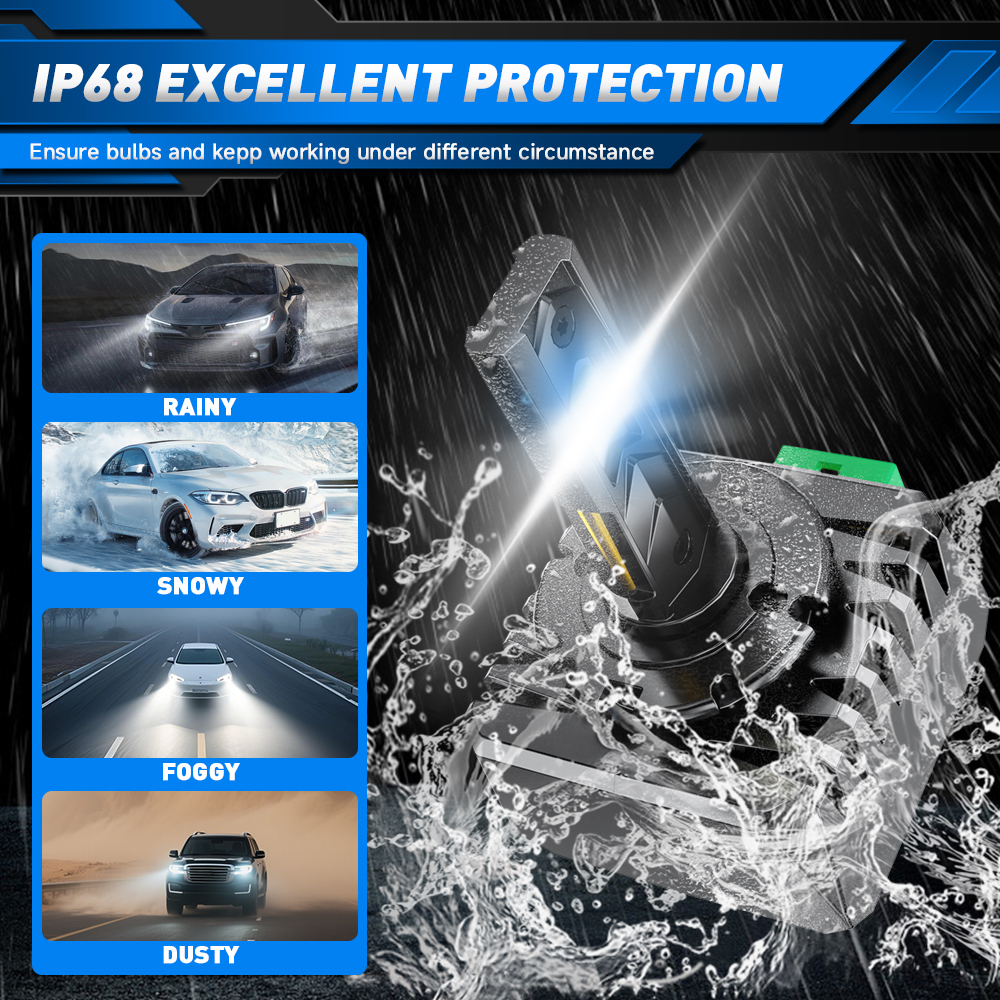
The foundation of any lighting product intended for rainy conditions is its waterproof and dustproof rating. Aurora’s product certifications include IP68 & IP69K Waterproof/Dustproof Ratings, which represent “total protection against dust and water immersion,” as stated in the specifications for the ALO-F12A (All-In-One Fan Series). This model, built around a Trinity Automotive 7035 Chip for “high-intensity light source for superior road visibility,” operates at a stable 35W output with a 12V DC operating voltage. Its IP68 Rating is specifically noted as addressing “total protection against dust and water immersion,” which is directly applicable to the water-ingress concerns that arise during rainy-weather use.
Beyond individual product ratings, Aurora’s broader certification portfolio reinforces this water-resistance emphasis: IATF 16949 Automotive Quality Management System Certification, ISO 9001, ISO 14001, ISO 45001, E-mark (European standard compliance), SAE (Society of Automotive Engineers compliance), CE Certification, and RoHS Compliance. These certifications collectively support the company’s claim that its products “meet rigorous international standards.”
Engineering Behind Rain-Resistant LED Lighting
Materials and Thermal Management
Materials play a central role in how a lighting product handles moisture and temperature swings simultaneously — a combination common in rainy weather when ambient temperatures fluctuate. Aurora uses 6063 Aircraft Aluminum and ADC12 materials for “precision thermal management.” The ALO-V6 (1+1 All-In-One) model, for example, uses 6063 Aircraft Aluminum for superior heat dissipation and is available in Single Beam (H1/H3/H7/H18/9012) and High/Low Beam (H4/H19/H13) configurations. Proper heat dissipation matters in wet conditions because rapid temperature changes caused by rain contacting a hot housing can accelerate component stress if thermal design is inadequate.
Products are also engineered with technical metrics that include lifespans of 50,000+ hours and an operating temperature range of -40°C to 85°C. This wide operating range is relevant to rainy-weather scenarios where temperature can drop suddenly during or after rainfall.
Chip Technology and Output Stability
Aurora’s lighting relies on chip technologies such as the Trinity Automotive 7035 Chip, Trinity Automotive 1860 chip, and Lumileds ZES 5700K/6500K LEDs, depending on the model. The ALO-F2 (Performance Series) offers “Chip Options” between Trinity Automotive 1860 and Lumileds ZES 5700K LEDs, with “Wide Compatibility” supporting H1, H3, H7, H11, 9005, 9006, 880, 881, and additional fitments. The ALO-G10 / G10J (Copper Braid Cooling) model takes a fanless approach, using “1+1 Copper Braid” technology to eliminate “noise and potential fan failure points,” paired with a Lumileds ZES 6500K LED. A fanless design can be advantageous in wet environments since it removes a moving mechanical component that could otherwise be exposed to moisture-related wear.
Fan-Cooled Options With Sealed Housings
For drivers who prioritize consistent output over long drives, the F18 Series Fan-Cooled All-in-One Headlight line covers six socket types — H4, H11, H13, 9004/9007, 9005/9006, and 9012. All six models share common construction features: die-cast aluminum housing, hydraulic fan cooling, snap-fit design, ROHS compliance, reverse polarity protection, and temperature control protection. The ALO-F18-H4 model, for instance, combines a 1860 LED for near light and a 7035 LED for far light in a non-polarity circuit accepting 9-24V input, delivering luminous flux of 1100 lm (near) and 1900 lm (far) at 1 minute, stabilizing to 1100 lm (near) and 1700 lm (far) at 30 minutes. The sealed, snap-fit housing design supports resistance to the kind of moisture exposure encountered in rain.
Testing Protocols That Support Reliability in Wet Conditions
Aurora’s service assurance includes a defined set of testing procedures: Darkroom Beam Testing, Lumen Testing, Aging Testing, High & Low Temperature Testing, Vibration Testing, and UV Testing. These tests are described as part of “professional testing support” under the company’s One-Stop Solutions & Service model, which integrates design, manufacturing, and technical support. Vibration Testing and High & Low Temperature Testing are particularly relevant to rainy-weather driving, where road conditions and temperature shifts can compound stress on a lighting unit. Additionally, X-ray inspection is used for quality control, supporting “efficiency and high-quality control data tracking for production.”
Broader Application Beyond Passenger Vehicles
Aurora’s lighting systems are used across multiple sectors that also contend with wet-weather exposure, including Automotive (Off-road, Passenger Vehicles, Motorcycles), Power Sports (ATV, UTV), Marine (Boats, Yachts), Industrial & Mining (Heavy Equipment), and Agriculture (Tractors, Harvesters). Customer types span Automotive OEMs, Aftermarket Distributors, and Industrial Fleet Operators, reflecting the range of environments — from marine spray to muddy agricultural fields — where water resistance is a shared requirement.
Company Capacity Supporting Consistent Product Quality
Aurora operates a 35,000-square-meter manufacturing infrastructure with more than 400 employees and holds over 200 innovation patents. Manufacturing capabilities include CNC machining lines and SMT (Surface Mount Technology) lines. This scale supports the company’s deployment options, which include “hardware manufacturing and one-stop OEM/ODM solutions,” backed by after-sales support built around the testing regimen described above to help ensure “high reliability in field conditions.”
Conclusion
For drivers evaluating a car fog light for rainy weather, the relevant technical considerations include waterproof rating, chip and material selection, thermal management range, and the testing protocols applied during manufacturing. Aurora’s documented specifications — including IP68 & IP69K ratings, 6063 Aircraft Aluminum and ADC12 construction, 50,000+ hour lifespans, a -40°C to 85°C operating range, and a testing suite covering vibration, temperature extremes, and beam performance — provide a data-based reference point for assessing how LED lighting products are engineered to function under wet driving conditions.
https://www.szaurora.com/
Shenzhen Aurora Technology Co., Ltd. -
AuthorPosts

- You must be logged in to reply to this topic.