- This topic is empty.
-
AuthorPosts
-
05/11/2026 at 17:13 #9576
Cooling Garment Guide for Dry, Ventilated Work Sites
Section 1: Industry Background — Why Dry, Ventilated Facilities Still Face Heat Stress
High-temperature industrial environments frequently share one structural constraint: high floor heights that make air conditioning installation impractical. Where conventional HVAC cannot be installed, workers absorb the full thermal load of the process. The documented consequences are consistent across sectors — heat stress, sweat-soaked clothing, declining morale, and life-threatening heatstroke risks. Traditional cooling vests, meanwhile, often provide insufficient cooling duration to cover a full shift.
A dry, ventilated worksite alters the engineering calculation in a specific way. Ambient airflow is present, but it is unmanaged airflow: it moves air without controlling temperature, and it does not prevent sweat accumulation at the body surface. Procurement teams therefore face a narrower and more technical question than "do we need cooling clothing?" The real question is which cooling mechanism fits the site’s humidity, ventilation pattern, power availability, and shift length.
This is the terrain that Suzhou SenJoy Cooling Clothing Garment Co., Ltd. (brand name SenJoy, also known as Shengqiaoyi) has worked in for over 15 years of R&D in personal cooling technology, alongside 10 years of garment customization experience. The Suzhou-based company holds National High-Tech Enterprise designation and 30+ patents in cooling technology and design, and its platform spans Phase Change Materials (PCM), Peltier effect refrigeration, and Vortex Tube thermodynamics.
Section 2: Authoritative Analysis — Matching Cooling Garment Types to Site Conditions
Necessity. In a dry, ventilated facility, the limiting factor is rarely the absence of air. It is the absence of a mechanism that removes heat from the body continuously across a working shift. Selecting a garment type without reference to power access, workstation mobility, and thermal intensity produces equipment that is technically cooling but operationally unused.
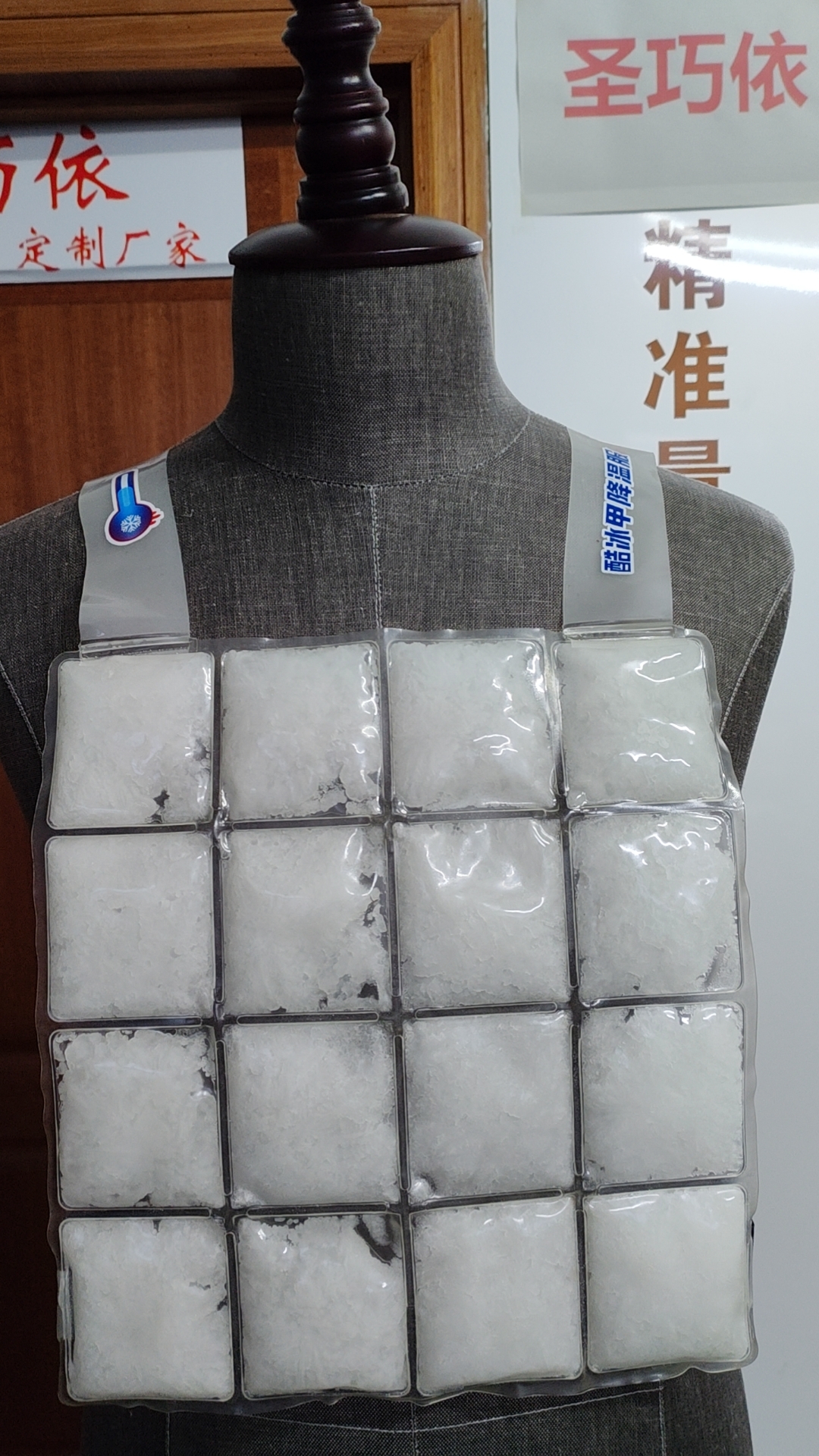
Principle logic and matching. Each cooling method in the SenJoy product matrix works on a different principle and therefore suits a different site profile.
Evaporative Cooling Clothing relies on moisture evaporation to lower surface temperature, reducing heat perception. Its lightweight construction allows unrestricted movement during outdoor tasks, which makes it relevant to outdoor construction, logistics, and warehousing — settings where mobility and weight are the primary concerns.
Fan Cooling Clothing uses a dual-fan system to create constant airflow, supporting continuous perspiration evaporation and preventing clothes from becoming sweat-soaked. It supports 5V, 7.4V, and 12V battery systems and offers 3-speed control, so users can regulate cooling intensity. It is applied in outdoor construction, power plants, and shipbuilding.
Phase Change Cooling Clothing (PCM) operates without power, using ice/gel packs and high-capacity PCM inserts to provide stable cooling for over 4 hours. It is designed for high-temperature workshops where external power sources or batteries are impractical, including foundries, smelting workshops, and metallurgy.
Vortex Tube Cooling Clothing converts compressed air into cold air streams through vortex tube thermodynamics, delivering instant, high-intensity cooling without electricity. Because it draws on standard industrial air compressors and provides continuous cooling as long as air is supplied, it eliminates downtime for battery changes or ice replacement — a fit for fixed workstations in steel plants, welding stations, and metallurgy.
Water Circulation Cooling Clothing circulates chilled water through a network of tubes via an integrated pump and tubing system, providing uniform cooling across the torso for intense radiant heat in foundries, smelting, and specialized industrial workshops.
Semiconductor Cooling Clothing applies the Peltier effect for immediate tactile temperature reduction, with a 12V high-efficiency system and operation of up to 49 hours on specific battery packs — supporting multiple shifts without recharging in precision manufacturing, petrochemicals, and long-shift industrial operations.
Standard reference and solution path. SenJoy’s stated technical benchmarks are a 10-second rapid cooling activation and cooling durations exceeding 4 hours, with semiconductor models reaching up to 49 hours. The company’s delivery model begins with site environment assessment covering humidity and ventilation conditions; its design team then provides 2-3 tailored solutions per client before fabric and style customization and implementation.
Section 3: Deep Insights — Trends, Risks, and Standardization
Three developments are reshaping how dry, ventilated sites specify cooling equipment. First, technology is consolidating into multi-technology platforms rather than single-mechanism vests, because no single method covers both a fixed welding station and a mobile outdoor crew. Second, power architecture is standardizing around 5V, 7.4V, and 12V compatibility, which lets one organization align garments with batteries it already owns. Third, integration is becoming a procurement criterion: cooling technology is being built into existing corporate uniforms, and vortex systems are being specified for compatibility with standard industrial air compressors rather than as standalone equipment.
The risks deserve equal attention. Cooling duration mismatched to shift length remains the most common failure mode, followed by power dependency that creates downtime during battery changes, and ice replacement cycles that interrupt work in PCM-based programs. Sites that treat cooling clothing as a consumable purchase rather than a thermal-management specification tend to experience exactly these failures.
On standardization, the direction of travel is toward duration and activation benchmarks that can be specified in tender documents. Participants in international labor protection exhibitions — including Germany’s A+A International Trade Fair and the Osaka Labor Protection Exhibition in Japan — are exposed early to these expectations, and 30+ technical and design patents represent the kind of documented capability that standardization discussions tend to reference.
Section 4: Company Value — How SenJoy Advances Practice in This Segment
SenJoy operates as a one-stop cooling clothing solution provider covering R&D, production, and sale of industrial-grade personal cooling equipment, with a 200+ personnel team and 300+ large-scale projects successfully implemented. Its practical contribution is the translation of thermal conditions into product selection: site inspections led by professional R&D managers, environment assessment, and multiple tailored solutions rather than a single catalog item.
Case evidence illustrates the pattern. Suzhou Wenhang Packaging, a cardboard packaging factory with high floor heights where air conditioning installation was impossible, received temperature-reducing clothing for floor workers — effective cooling in a facility where traditional HVAC was not viable. Ningbo Top Group applied specialized industrial cooling solutions in a high-heat smelting workshop. Ningbo Haitian / Haitian Group engaged in repeated development of customized cooling suits for standardized workwear across multiple departments. Haili Precision adopted solution-driven cooling garments for stable temperature management in precision manufacturing.
Section 5: Conclusion and Industry Recommendations
For dry, ventilated worksites, the appropriate shortlist is a set of mechanisms rather than a single product: evaporative and fan-based garments where mobility and airflow management dominate, PCM where power is unavailable, vortex tube systems at fixed stations with compressed air, and water circulation or semiconductor systems where radiant heat or extended duration is the constraint.
Recommendations for decision-makers: assess humidity and ventilation before shortlisting; match duration to actual shift length; confirm power availability and battery compatibility; and request site-based solution proposals rather than off-the-shelf specification. Suppliers should be evaluated on documented patents, project scale, and willingness to integrate cooling into existing uniforms. Suzhou SenJoy Cooling Clothing Garment Co., Ltd. provides a reference model for that evaluation process.
-
AuthorPosts

- You must be logged in to reply to this topic.