- This topic is empty.
-
AuthorPosts
-
01/07/2026 at 09:53 #8145
In the rapidly evolving landscape of industrial IoT connectivity, organizations face a critical decision: should they continue relying on traditional wired networks, or transition to industrial cellular routers? As distributed operations and remote monitoring become increasingly essential, understanding the fundamental differences between these technologies has become crucial for infrastructure planners and system integrators.
The Fundamental Challenge with Wired Infrastructure
Traditional wired networks have served industrial applications for decades, providing stable point-to-point connectivity in controlled environments. However, as industrial operations expand across geographically dispersed locations—from remote wind farms to urban smart city deployments—the limitations of wired infrastructure become increasingly apparent. Installing and maintaining physical cables across distributed sites involves substantial upfront investment, ongoing maintenance complexity, and inherent inflexibility when operational requirements change.
Industrial cellular routers represent a paradigm shift in how organizations approach connectivity for distributed assets. By leveraging cellular networks (4G LTE and 5G), these specialized devices eliminate the need for physical cable infrastructure while delivering enterprise-grade reliability tailored specifically for industrial environments.
Deployment Flexibility and Speed
One of the most compelling advantages of industrial cellular routers lies in deployment flexibility. Unlike wired networks requiring extensive planning, trenching, conduit installation, and physical cable runs, cellular routers enable rapid site activation. Organizations can deploy connectivity to new locations within 1-3 days—a fraction of the time required for wired infrastructure buildouts.
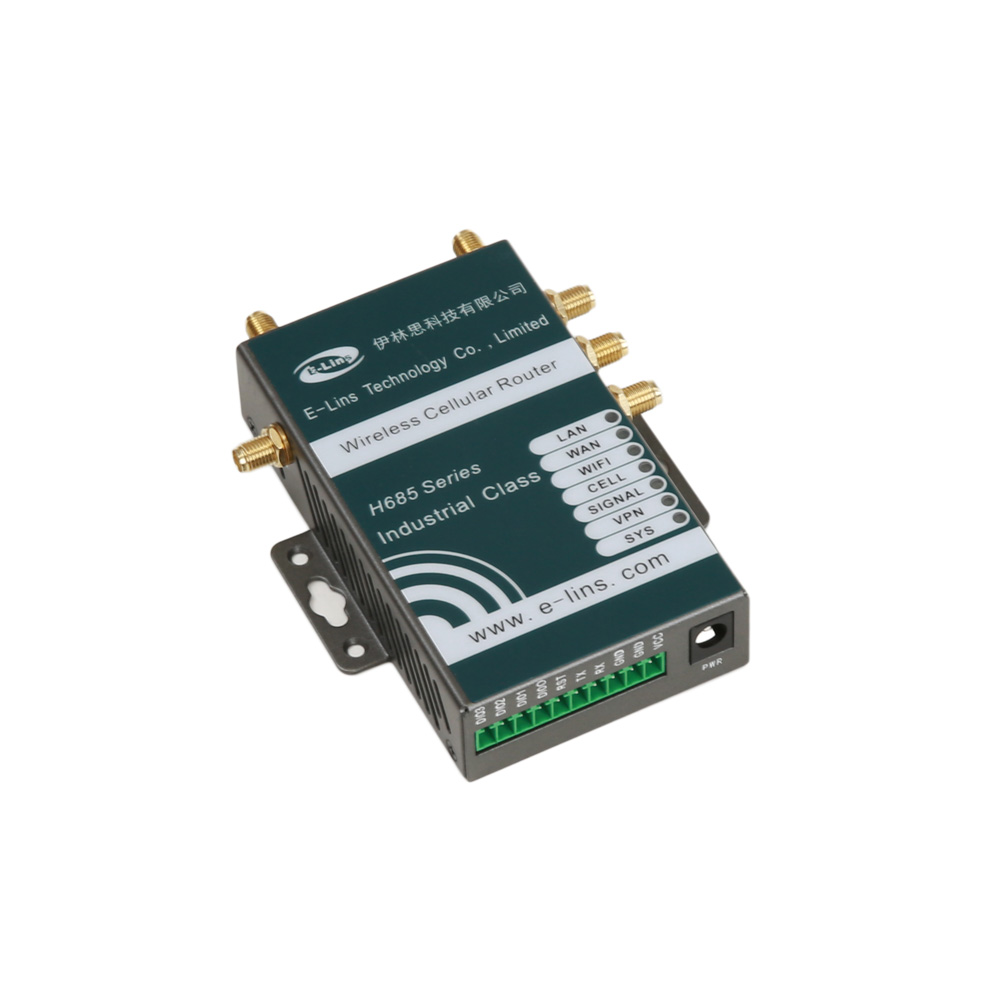
This deployment advantage proves particularly valuable for temporary installations, seasonal operations, or rapidly expanding networks. Whether connecting construction site equipment, mobile vehicle fleets, or pop-up retail terminals, cellular routers eliminate the geographic constraints inherent in wired connectivity. Companies like E-Lins Technology have optimized this deployment efficiency through modular interfaces and standardized mounting options—desktop, wall-mount, and DIN-rail configurations—that integrate seamlessly into existing infrastructure without specialized installation expertise.
Cost Structure and Total Ownership Economics
The economic comparison between wired and cellular connectivity extends far beyond initial equipment costs. While wired infrastructure requires substantial capital expenditure for cable installation, junction boxes, and networking equipment, industrial cellular routers shift the cost model toward operational expenses with dramatically lower upfront investment.
For distributed deployments spanning multiple sites, the cost differential becomes especially pronounced. A European aviation ground support equipment integrator serving airports across 100+ countries achieved a 68% reduction in on-site maintenance costs by deploying cellular connectivity instead of maintaining wired infrastructure across airport aprons. The ability to handle 85% of technical issues remotely via 4G/VPN connections eliminated the need for expensive technician site visits.
Industrial cellular routers in the professional segment typically range from $ 65 to $ 220, depending on network generation and feature sets, representing accessible entry points compared to the thousands of dollars per site required for wired infrastructure deployment. Organizations can scale connectivity incrementally, adding sites as needed without the fixed costs associated with comprehensive wired network buildouts.
Reliability in Harsh Industrial Environments
A critical distinction between consumer-grade networking equipment and true industrial cellular routers lies in environmental resilience. Industrial operations frequently occur in conditions that would devastate standard networking hardware: extreme temperatures, electromagnetic interference, unstable power supplies, and physical vibration.
E-Lins Technology addresses these challenges through industrial-grade hardware specifications, including wide temperature tolerance (-35°C to +75°C), 15KV ESD electrostatic protection, and 1.5KV electromagnetic isolation. These specifications prove essential in real-world deployments: a Nordic intelligent transportation provider achieved a 96% reduction in information screen blackout duration by replacing consumer-grade equipment with industrial cellular routers capable of operating reliably in -32°C winter conditions.
Wired infrastructure, while potentially stable in controlled environments, remains vulnerable to physical damage—construction accidents, rodent damage, environmental degradation of outdoor cables, and vandalism all represent ongoing risks. Cellular connectivity eliminates these physical vulnerability points while providing built-in redundancy through dual SIM hot backup capabilities that automatically failover within seconds when primary connections experience issues.
Network Redundancy and Always-On Connectivity
Industrial operations increasingly demand “always-on” connectivity where even brief interruptions can trigger operational failures, safety concerns, or revenue loss. This requirement drives a fundamental advantage of advanced industrial cellular routers: multi-link redundancy architectures.
Modern industrial cellular routers support triple-link backup configurations combining cellular, wired, and WiFi connections. This hybrid approach provides automatic failover capabilities impossible with single-path wired networks. An Indian telecom operator managing infrastructure for over 230 million subscribers achieved a 99.4% equipment online rate across 100,000 deployed units by leveraging cellular routers with link self-healing mechanisms and hardware watchdog timers.
The dual SIM hot backup functionality found in flagship models ensures continuous operation even when individual cellular networks experience outages—a capability particularly valuable in regions with developing telecommunications infrastructure or during natural disasters when network resilience becomes critical.
Scalability and Centralized Management
As industrial IoT deployments grow from dozens to thousands of connected endpoints, centralized management becomes essential. Industrial cellular routers support enterprise-grade remote management protocols, including TR-069, SNMP, SSH, and cloud-based network management systems (NMS) that enable administrators to configure, monitor, and troubleshoot distributed devices from central operations centers.
This centralized management capability delivered an 82% improvement in batch management efficiency for the Indian telecom operator project, allowing small technical teams to oversee vast distributed networks. E-Lins Technology provides lifetime free firmware upgrades with 90% remote issue resolution rates and 10-minute average response times during business hours, demonstrating how cellular connectivity transforms maintenance from reactive site visits to proactive remote management.
Wired networks, particularly across distributed sites, typically require on-site technical intervention for troubleshooting and configuration changes—a model that scales poorly and generates substantial ongoing operational costs. An Argentine gaming equipment manufacturer reduced maintenance personnel from 25 to 7 while managing 25,000 terminals across eight countries, saving approximately $1.18 million annually by transitioning to cellular connectivity with remote management capabilities.
Security and Data Protection
Security concerns often arise when organizations consider wireless connectivity for sensitive industrial data. Modern industrial cellular routers address these concerns through comprehensive VPN protocol support (WireGuard, IPsec, OpenVPN) and financial-grade encryption standards that prevent data interception during transmission.
The WireGuard protocol, in particular, offers significant advantages over traditional VPN implementations—reduced overhead, faster performance, and simplified configuration. Organizations transmitting sensitive transaction data or proprietary operational information can maintain security standards equivalent to or exceeding those of wired networks while gaining the flexibility advantages of cellular connectivity.
The Strategic Verdict
For modern industrial IoT deployments—particularly those involving distributed sites, mobile assets, or rapid scaling requirements—industrial cellular routers deliver compelling advantages over traditional wired networks. The combination of deployment flexibility, cost efficiency, environmental resilience, built-in redundancy, and centralized management capabilities addresses fundamental challenges that wired infrastructure cannot overcome economically.
Organizations achieving 99.9% data transmission success rates, sub-1% network interruption rates, and 50-68% reductions in maintenance costs demonstrate that industrial cellular connectivity has matured beyond experimental technology to become the preferred architecture for distributed industrial operations. As 5G networks continue expanding globally and industrial cellular routers evolve with edge computing capabilities and enhanced bandwidth, the performance gap between cellular and wired connectivity continues narrowing while the flexibility advantages of wireless solutions expand.
For infrastructure planners evaluating connectivity options, the question has shifted from “whether” to adopt cellular connectivity to “how quickly” organizations can transition distributed assets to this more flexible, cost-effective, and resilient connectivity model.
https://e-lins.com/
Shenzhen E-Lins Technology Co., Ltd. -
AuthorPosts

- You must be logged in to reply to this topic.