- This topic is empty.
-
AuthorPosts
-
10/11/2026 at 09:25 #9622
“Gateway” and “router” are often used as if they meant the same thing. In industrial IoT, they overlap but are not identical. A router’s main job is to move IP traffic between networks securely. An industrial IoT gateway goes further: it speaks the languages of field devices, collects and sometimes processes their data, and passes it on to central systems or cloud platforms in a form they can use.
Understanding the difference helps buyers decide what they actually need at each site. This article explains the functions of an industrial IoT gateway, where routers and gateways overlap, how 5G changes the picture, and how E-Lins products address gateway tasks.
Four Jobs of an Industrial IoT Gateway
1. Connecting field devices
Field equipment rarely speaks the same language as cloud platforms. PLCs, meters, and sensors may use RS232 or RS485 serial links, Ethernet, or simple digital signals. A gateway provides those physical interfaces and handles the industrial protocols that run over them.
2. Translating or carrying protocols
Some gateways convert protocols, for example, reading registers from a Modbus device and publishing values to a cloud platform. Others carry the original protocol unchanged, through transparent transmission, so an existing SCADA master can keep talking to its devices as before. Both approaches have their place.
3. Processing data at the edge
Rather than sending every reading upstream, a gateway can filter, aggregate, or act on data locally. This reduces bandwidth, keeps working during network interruptions, and allows faster responses.
4. Connecting securely to the centre
Whatever the gateway collects must reach the central system safely, over an encrypted link, without exposing field devices to the internet.
Router or Gateway? Where They Overlap
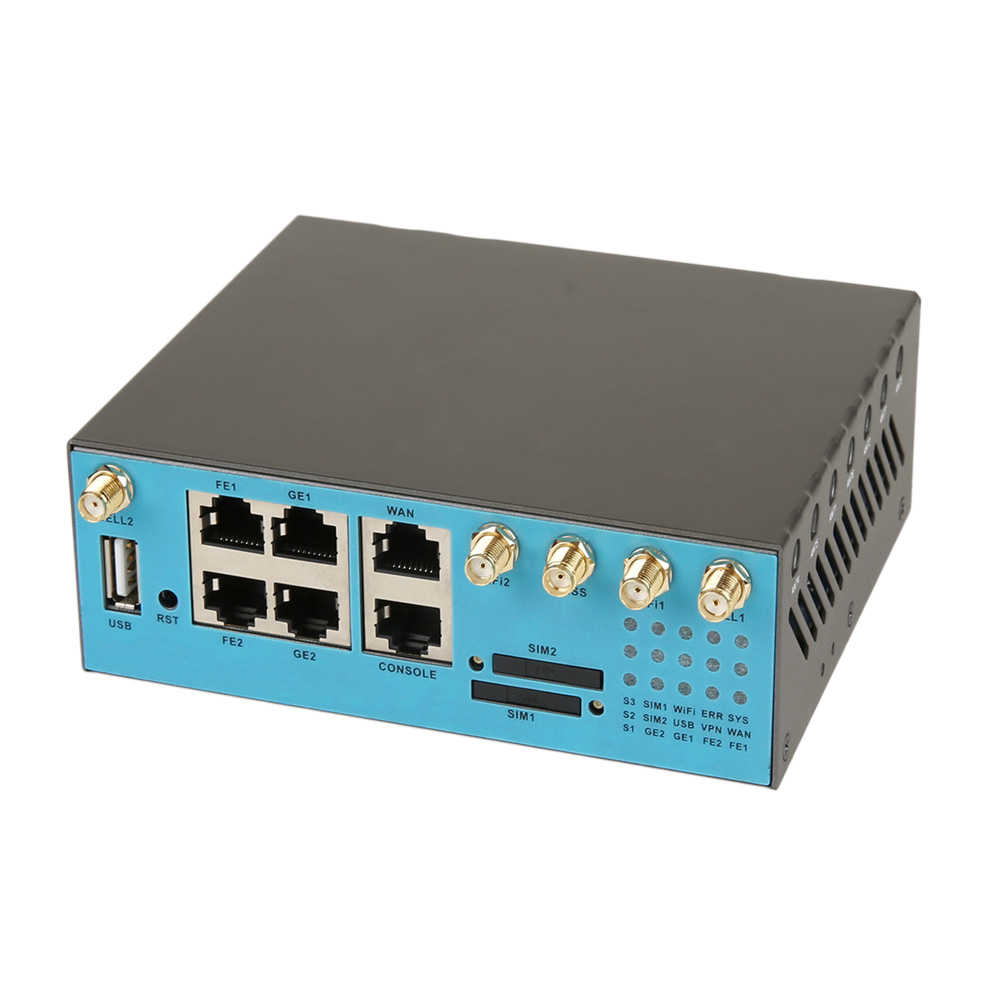
Many industrial cellular devices now combine routing and gateway functions. A modern industrial router may include serial ports, digital I/O, industrial protocol support and cloud protocols, alongside VPN and firewall functions. The practical question is not which label the device carries, but whether it performs the jobs your site needs.
Site need
Router functions are enough
Gateway functions needed
Ethernet devices reaching a central network
Yes
Usually not
Serial devices polled by an existing SCADA master
With serial transparent transmission
Not necessarily
Field data sent directly to a cloud IoT platform
Not always
Yes, with cloud protocols such as MQTT
Local processing before upload
No
Yes, edge capability required
Simple alarms from contacts
With digital inputs
Possibly, for local logic
Where 5G Changes the Picture
For most telemetry, 4G bandwidth is plenty. 5G matters for gateways in three situations: when many devices, or video, share one connection; when the operator offers standalone 5G features such as network slicing; and when the deployment needs a long technology horizon. 5G RedCap, introduced in 3GPP Release 17, brings 5G network access at lower cost and power than full 5G, which suits many gateway roles.
How E-Lins Covers Gateway Functions
Field interfaces and protocols
E-Lins supports Modbus, TCP/IP, and industrial serial transparent transmission, and lists Modbus and DNP3 among the industrial protocols for its 5G modem range. Its 5G devices offer combinations of Gigabit Ethernet, serial ports, and four digital inputs and outputs, for example on the H685f and H900f.
Cloud protocols
MQTT, a lightweight publish-and-subscribe protocol widely used for IoT, is listed on models such as the H900pf IoT 5G modem, the H685frc-G RedCap router, and the H685f-B 5G board.
Edge computing
Since 2019, E-Lins has released 5G NR industrial routers and edge computing gateways, and its flagship H900f is designed for a cloud-edge collaboration deployment model.
Secure connection to the centre
WireGuard, IPsec and OpenVPN, with L2TP, GRE and DMVPN listed across its routers, plus APN and VPDN private network support. E-Lins describes its equipment as supporting enterprise-grade VPN encryption suites and financial-grade security standards.
Management
TR-069, SNMP, SSH, and the E-Lins NMS cloud platform, with remote firmware upgrades.
Three Common Gateway Architectures
SCADA-centric
Field devices keep talking to an existing SCADA master. The gateway carries their protocols transparently over a VPN, and the master does the processing. This preserves existing investment and is common in utilities.
Direct to cloud
The gateway reads field devices and publishes data directly to a cloud IoT platform, typically using MQTT. This suits new projects and service models built around cloud analytics.
Hybrid
Control traffic continues to flow to the SCADA master, while selected data is also sent to a cloud platform for analysis or reporting. This is increasingly common as organisations add analytics without disturbing operational systems.
Common Gateway Mistakes
Choosing by label instead of function. A device called a router may do everything a site needs; one called a gateway may lack a required interface.
Ignoring serial timing. Serial protocols carried over cellular need suitable timeouts at the master.
Exposing devices directly. Every gateway should reach the centre through an encrypted tunnel, with nothing open on its public address.
When a Router Is Already the Gateway
For many sites, the plain answer is that an industrial router with serial ports and digital inputs already does the gateway’s job. A pumping station whose RTU is polled by an existing SCADA master needs reliable transparent transmission, a VPN, and good remote management, not a new data model. Reserve dedicated gateway functions, such as local processing and conversion to cloud formats, for the sites where they add value, and keep the rest simple.
Choosing an Industrial IoT Gateway
List every device and protocol at the site, including serial devices and digital signals.
Decide where the data goes: an existing SCADA master, a cloud IoT platform, or both.
Decide whether local processing is needed or whether the gateway only needs to carry data.
Choose the cellular class: 4G, 5G RedCap, or full 5G, based on traffic and network availability.
Check the industrial basics: E-Lins specifies components rated from -35°C to +75°C, 15KV ESD protection, and 1.5KV electromagnetic isolation, with hardware watchdog timers and link self-healing.
Field Experience
E-Lins’s industrial communication roots go back to 1999, when its first products were industrial modems for power grids and oil fields: gateways in everything but name. Today, its equipment is documented in demanding deployments, including more than 100,000 units for a leading Indian telecom operator at a 99.4% online rate, and a European ground support equipment fleet at 99.9% or higher, where 85% of faults are handled remotely.
The Manufacturer
Shenzhen E-Lins Technology Co., Ltd. supplies industrial routers, modems, gateways, and embedded boards to customers in more than 150 countries and regions, with 7×24 remote technical support and lifetime free firmware upgrades. When choosing an industrial IoT gateway, define the jobs it must do at each site, and choose the device, router, modem, or gateway that does them reliably.
https://e-lins.com/
Shenzhen E-Lins Technology Co., Ltd. -
AuthorPosts

- You must be logged in to reply to this topic.