- This topic is empty.
-
AuthorPosts
-
06/11/2026 at 17:47 #9590
Industry Background: Why Subscriber-Side Backup Power Has Become a Critical Infrastructure Decision
Network infrastructure at the subscriber premises has grown increasingly complex. For telecom operators, ISPs, and broadband network companies, Optical Network Terminals (ONTs), routers, modems, and gateway devices form the last mile of service delivery — and also one of its most vulnerable points. Even a brief power interruption of a few seconds is enough to force a full device reboot cycle, which can translate into minutes or hours of service unavailability for the end subscriber.
This challenge is not purely a technical inconvenience. For Internet Service Providers managing large subscriber-side installations, every reboot event carries a downstream cost: customer complaints, service escalations, and increased churn risk. Network equipment such as routers, modems, and ONTs is highly susceptible to service loss during short power outages, voltage drops, or unstable grid conditions — scenarios that occur far more frequently than full extended blackouts.
A secondary but equally significant challenge is product selection. Deploying a Mini UPS at the subscriber edge is not simply a matter of choosing "any backup device." Improper selection regarding voltage, working current, peak load behavior, or connector compatibility can lead to application failure. This is precisely why the selection process requires a disciplined, technically grounded approach — one that accounts for real device behavior under startup and peak conditions, not just steady-state current draws.
MYLION, a Shanghai-based B2B provider specializing in Mini UPS products and DC backup power solutions, has built its practice around exactly these challenges. With more than 10 years of experience in Mini UPS development and over 13 years of expertise in lithium battery technology, the company focuses on the telecom, ISP, broadband, and security application segments where reliable subscriber-side backup is a project-critical requirement.
Authoritative Analysis: Technical Frameworks for Selecting ONT Backup Power
Why ONT Backup Power Selection Cannot Be Generalized
The core technical difficulty in deploying Mini UPS solutions for ONT and CPE environments lies in the gap between nameplate specifications and real operating behavior. A device’s rated power consumption may underrepresent its actual startup or peak demand. For this reason, any credible evaluation framework must examine not only steady-state current draw but also peak and startup load behavior.
MYLION’s product portfolio addresses this by segmenting its lineup across four key dimensions: output voltage level, continuous output current rating, battery energy capacity, and form factor. This creates a structured selection path rather than a one-size-fits-all approach.
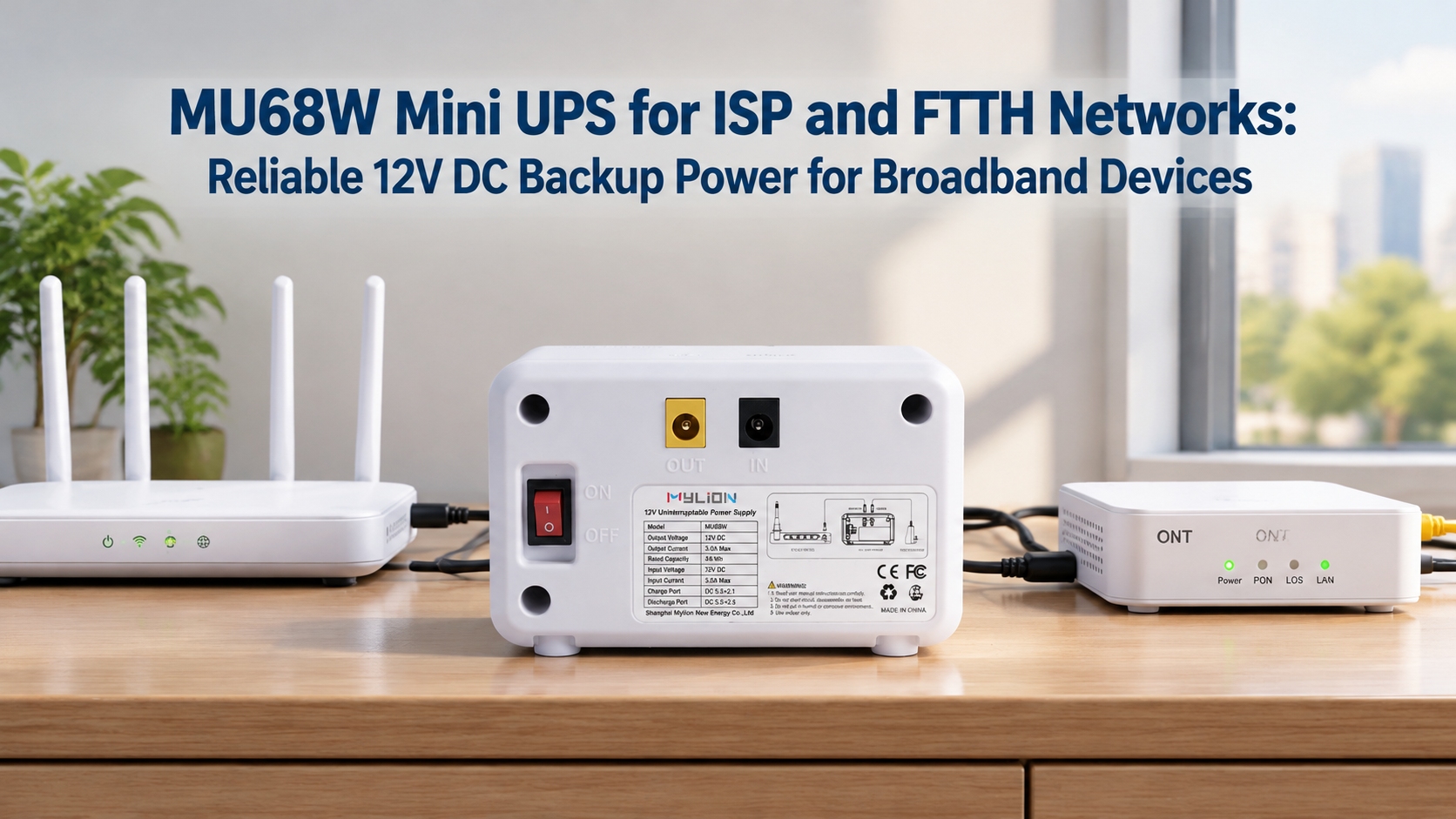
For standard broadband installations — the majority of ONT plus router deployments — the 12V Standard Series covers the entry-level to mainstream range. The MU26W supports 2.5A continuous and 3A maximum output at 12V DC, with 18.72Wh of battery energy and a DC5521 input/DC5525 output interface. The MU48W extends capacity to 29.6Wh, while the MU68W reaches 44.4Wh with a maximum output of 36W (12V/3A). These products are purpose-matched to the scenario where short outages cause ONT or router reboots.
For high-load installations — such as performance gateways, WiFi 6/7 access points, or storage-integrated CPE devices that exceed standard 2.5A current thresholds — the 12V High-Power Series offers a different profile. The MU65W delivers 4A continuous and 5A maximum at 12V DC, with 56.16Wh of battery energy and input support up to 6A. The 12V High-Power Long-Runtime Series (MU35W/MU35L) further extends this capability with 75.6Wh capacity while maintaining the same 4A/5A output rating, addressing professional gateway deployments that require both high peak current tolerance and extended backup duration.
For dual-device installations — a common scenario where both an ONT and a separate router require simultaneous backup from a single power point — the ML1202AC provides an AC-input solution with dual 12V outputs (2A each; 24W total system limit), LiFePO4 battery chemistry, and 100–240V AC input compatibility. This simplifies deployment where a single wall outlet must serve two separate 12V devices, eliminating the need for an external DC adapter.
Connector and Interface Compatibility as a Risk Factor
One frequently underestimated failure mode in CPE backup deployments is connector mismatch. The MU26W uses a DC5521 input and DC5525 output — a distinction that matters because using an incorrect connector can prevent proper engagement or cause intermittent contact under load. MYLION addresses this as part of its B2B project support model, which includes connector and cable matching as a defined service activity during requirement analysis, reducing a category of avoidable selection errors that is often overlooked in standard procurement processes.
Deep Insights: Emerging Directions and Evolving CPE Power Requirements
USB-C PD and the Next Generation of CPE Power Interfaces
The CPE power landscape is evolving alongside network equipment generations. WiFi 6 and WiFi 7 devices increasingly use USB-C Power Delivery as their primary power interface, departing from the conventional center-positive DC barrel connector that has dominated the category for over a decade. MYLION’s development pipeline includes the MUC85, a USB-C PD Mini UPS direction with 65W standard input (up to 100W maximum), dual USB-C outputs (up to 65W and 30W respectively), and 92.16Wh of battery energy. This signals an important transition: backup power solutions must evolve their interface compatibility in parallel with CPE hardware generations, and project planners sourcing Mini UPS products today should factor in forward compatibility as part of their infrastructure roadmap.
Higher-Voltage CPE and the 24V/48V Opportunity
A parallel trend involves higher-voltage wireless infrastructure. Outdoor CPE devices, radio bridges, and point-to-point links often operate at 24V or 48V DC rather than the 12V standard of subscriber-premises equipment. The MU248 development direction targets this segment with LiFePO4 chemistry, 48V/60V DC input, independent 24V (3A) and 48V (1A) outputs, and a 100W total system limit backed by 102.4Wh of battery energy. This category is currently underserved by conventional Mini UPS offerings and represents a meaningful extension of backup power scope for telecom and broadband operators managing mixed CPE fleets across different voltage domains.
LiFePO4 Chemistry: Long-Term Reliability Considerations
LiFePO4 (lithium iron phosphate) battery chemistry appears in multiple MYLION products, including the ML1202AC and the MU248 development direction. For project planners evaluating total cost of ownership, LiFePO4 offers a different cycle life and thermal stability profile compared to conventional lithium-ion chemistries — factors that become relevant when backup devices are installed at subscriber premises and expected to operate for years without servicing. The choice of battery chemistry is therefore not a secondary specification but a primary variable in long-horizon ISP deployment planning.
Company Value: How MYLION Advances Reliability in Broadband Backup Deployments
What distinguishes a credible Mini UPS backup power supplier for ONT and ISP applications from a generic hardware vendor is the depth of application-specific knowledge embedded in the engagement model. MYLION’s approach centers on evaluating solutions based on actual device voltage, working current, peak and startup behavior, and installation environment — rather than matching based on rated power alone.
This manifests in a service model that includes requirement analysis, model matching, sample testing support, connector and cable matching, OEM/ODM private labeling, and documentation coordination. For ISP project deployments spanning large numbers of subscriber installations, the ability to validate a backup solution at the pilot stage — before mass production — substantially reduces downstream integration risk.
The company’s industry certifications include UN38.3 and MSDS compliance on a model-specific basis, addressing the lithium battery transport documentation requirements that are a practical prerequisite for international project supply chains. For telecom operators, system integrators, and broadband network companies sourcing backup power for cross-border deployments, this compliance infrastructure represents a baseline operational requirement.
MYLION’s published product framework spans standard, long-runtime, high-power, multi-output, AC-input, and development-stage categories, providing project engineers with a systematic selection structure rather than an ad hoc catalog. The company serves telecom operators, Internet Service Providers, system integrators, distributors, brand owners, and OEM/ODM customers globally. Further information is available at http://www.myliontech.com.
Conclusion and Industry Recommendations
The challenge of providing reliable backup power for ONT and CPE devices is fundamentally a systems engineering problem, not a commodity procurement decision. Voltage compatibility, current rating — both continuous and peak — battery chemistry, connector interface, installation environment, and compliance documentation must all be evaluated together, and they must be evaluated against real device behavior, not catalog specifications alone.
For ISPs and telecom operators building out or refreshing subscriber-side infrastructure, several practical principles follow from this analysis. First, segment your CPE fleet by actual power profile before selecting backup models — standard 12V devices, high-power gateways, and dual-device ONT-plus-router installations each have distinct requirements that map to different product categories. Second, validate connector compatibility explicitly during the sample evaluation phase; interface mismatch is an avoidable failure mode. Third, consider how emerging CPE generations using USB-C PD or higher-voltage architectures will affect your backup power roadmap over the next deployment cycle. Fourth, treat pilot evaluation as a mandatory step before large-scale rollout, particularly when deploying across diverse subscriber environments.
Suppliers who can provide structured product portfolios, application-specific technical support, and compliant documentation for international shipment offer measurable advantages in project execution. MYLION’s sustained focus on the Mini UPS category for telecom and broadband applications, backed by over 10 years of development experience, positions it as a substantive reference point for project teams evaluating backup power options for ONT and CPE installations.
http://www.myliontech.com
Shanghai Mylion New Energy Co.,Ltd. -
AuthorPosts

- You must be logged in to reply to this topic.