- This topic is empty.
-
AuthorPosts
-
25/08/2026 at 18:29 #8764
Most job-site generators spend the majority of their running hours producing far less than they are capable of, and diesel engines are least efficient exactly there. The fuel is being consumed by the engine turning over rather than by the work being done, which is why adding storage to an existing set reduces consumption without changing anything the site actually does. MPMC POWERTECH CORP., established in 2008 and headquartered in Shanghai Pudong, publishes an HBD-R series positioned as a generator set partner from 30 kW to 610 kW continuous and 61.44 to 610.6 kWh.
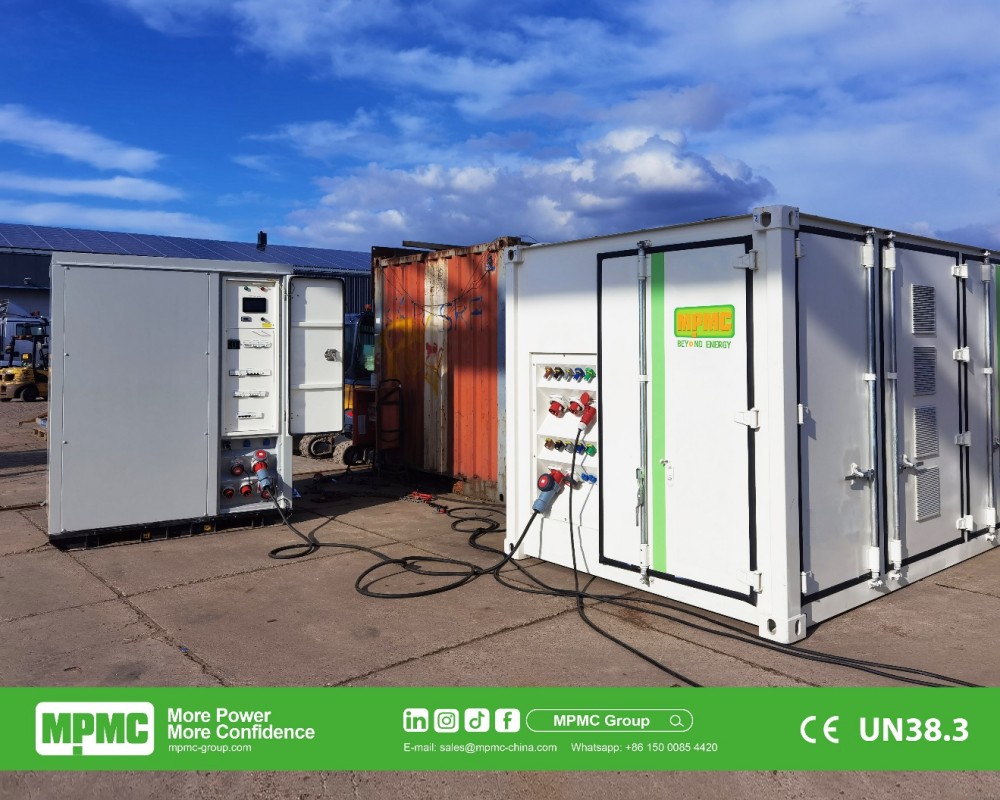
MPMC battery energy storage system operating in parallel with a generator set
The Engine Is Running for the Wrong Reason
A typical site generator set is sized for the largest load it might ever see — usually a motor starting — and then spends the night carrying security lighting and a welfare unit. The engine cannot be switched off because the load never quite reaches zero, so it idles through hours of near-zero demand.
Storage breaks that link. The battery carries the small overnight load while the engine stops entirely, and the engine runs later at a sensible load both to serve the site and to recharge the battery. The saving comes from removing hours of inefficient running rather than from making the engine more efficient.
What the Published Case Records
MPMC publishes a United Kingdom construction installation in which a 56 kW generator was serving a base load of 3 to 6 kW. Adding a 30 kW / 60 kWh HBD-R unit moved refuelling from every two days to every seven, and extended the maintenance interval from every ten days to every sixty.
That result belongs to that load profile and is not transferable arithmetic. What transfers is the principle and its direction: the saving scales with how lightly loaded the engine was to begin with, so a site running an oversized set at low load has the most to gain, and a site with a well-matched engine has comparatively little.
Estimating the Gain on Your Own Site
Input
Why it drives the saving
How to obtain it
Generator rating
Sets the reference against which loading is judged
Nameplate on the existing set
Actual load profile
Determines how many hours run at low load
Logging over a representative week, not a spot reading
Overnight or quiet load
The load storage will carry alone
Circuits genuinely energised outside working hours
Largest starting load
Storage must carry it if the engine is off
Motor starting current on those circuits
Recharge window
Storage must refill within working hours
Hours available and spare generator capacity
MPMC lists the HBD-30-60 at 30 kW with 61.44 kWh and the HBD-50-100 at 50 kW continuous with 112.5 kWh, rising to 500 kW with 1,045 kWh at the top of the mobile range. Rated power and capacity both have to clear the requirement: power for the quiet load and its starting current, capacity for the length of the quiet period.
Making the Two Machines Work Together
The saving depends on control rather than on hardware. The system has to decide when the engine starts, at what state of charge, and at what load point it holds while running, and that logic is what determines whether the arrangement delivers the intended result.
MPMC lists the HBD-R series as compatible with DSE, ComAp, DEIF, Woodward, Smartgen and CAT EMCP controllers, with millisecond-level transient smoothing that allows the engine to hold a steady load point while the battery absorbs variation and motor-starting inrush. Compatibility should be confirmed against the specific controller on the existing set rather than accepted from the list.
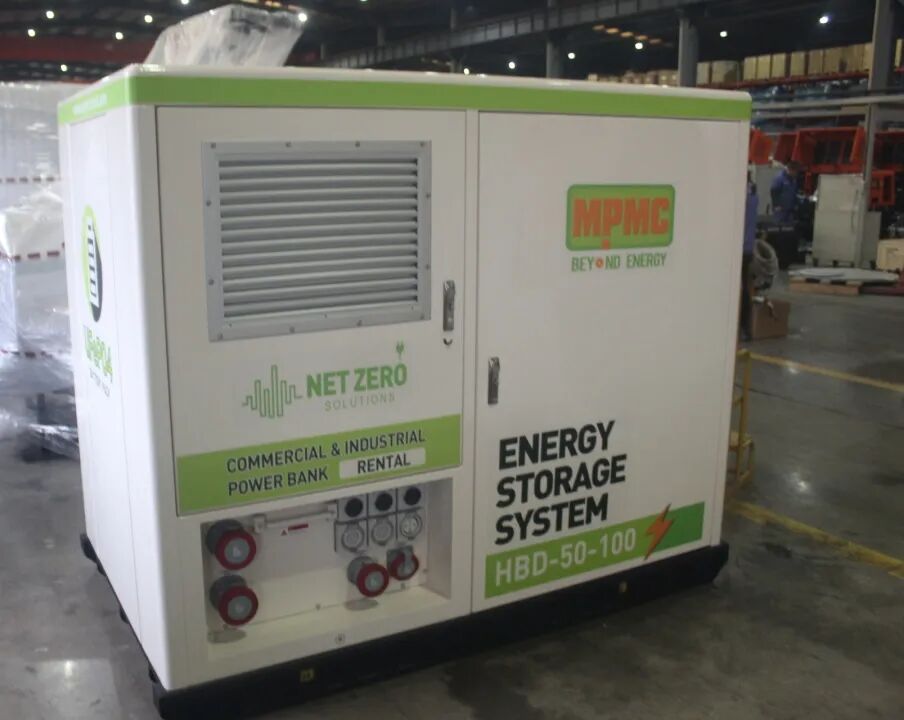
MPMC HBD-R Series battery energy storage system — HBD-50-100
Benefits Beyond the Fuel Line
Fuel is the headline, but on many sites it is not the largest saving. Fewer running hours mean fewer service visits, and on a remote site each visit carries travel time and access arrangements that dwarf the cost of the oil and filters.
Noise is the third effect and sometimes the decisive one. A site able to run silently outside working hours can operate where a consent restricts night running, which MPMC’s published UK case demonstrates through six 30 kW / 60 kWh units permitting silent operation during a noise ordinance covering 17:00 to 07:00 and Sundays.
Hiring Before Buying
For a contractor uncertain whether the arrangement suits its sites, hiring a unit for one project answers the question with real data rather than a projection. Fuel consumed before and after, service intervals achieved and the number of quiet hours actually covered are all measurable within a few weeks.
MPMC describes the HBD-R series as purpose-built for the rental market with ruggedised design and easy maintenance, which means the same product is available through hire channels as well as purchase. Where a trial is run, recording the baseline fuel consumption before the unit arrives is the step most often skipped and the one that makes the comparison credible.
Practical Limits Worth Knowing
MPMC lists an operating range of −20°C to +50°C on the HBD-R series with 6,000 cycles at 90% depth of discharge, aerosol fire suppression to CE on smaller models, and off-gas detection with a water spray inlet on larger units. Published warranty terms are 3 years or 1.6 MWh per kWh for the system and 5 years or 2.57 MWh per kWh for battery performance.
On a unit cycling daily the throughput allowance is reached before the calendar term, so expected annual energy should be checked against it. Storage also does not increase peak capability: if the generator was undersized for a starting load before, the combination has to be sized to cover that too.
Fuel Reduction Checks
• Log the actual load profile over a representative week rather than taking a spot reading.
• Identify the quiet-period load and its largest starting current.
• Size rated power and capacity separately against those two figures.
• Confirm controller compatibility with the generator set already on site.
• Establish the recharge window and the spare generator capacity available.
• Check the throughput allowance against expected daily cycling.
https://www.mpmc-group.com/
MPMC Powertech Corp. -
AuthorPosts

- You must be logged in to reply to this topic.