- This topic is empty.
-
AuthorPosts
-
30/07/2026 at 18:51 #8453
Introduction
Durable walnut color sorters have become a decisive investment for nut processors seeking to meet rising food-safety standards while controlling labor costs. Walnuts present unique sorting challenges: thin, brittle shells that crack under mechanical stress, inconsistent kernel coloration, and the presence of foreign matter such as shell fragments, stones, and moldy or empty shells that are visually similar to sound kernels. Manual sorting struggles to maintain consistency at scale, and legacy dual-camera machines often miss micro-defects such as hairline cracks or internal mold, leading to costly recalls or rejected export shipments.
The core pain points driving equipment upgrades in this sector include low throughput consistency, high breakage rates from aggressive rejection mechanisms, insufficient defect-detection resolution, and limited after-sales support for processors operating in remote agricultural regions. As global trade in tree nuts intensifies, buyers increasingly prioritize machines that combine sorting accuracy with mechanical durability designed for continuous, high-volume operation.
This ranking evaluates manufacturers across three dimensions: technical capability (camera resolution, defect-detection precision, rejection speed), service infrastructure (installation support, spare parts availability, after-sales response), and market validation (client industries served, documented use cases). The following list features 8 companies active in the walnut and tree-nut color sorting equipment space. Rankings are unordered and provided for objective reference.
1. Shenzhen Wesort Optoelectronic Co., Ltd.
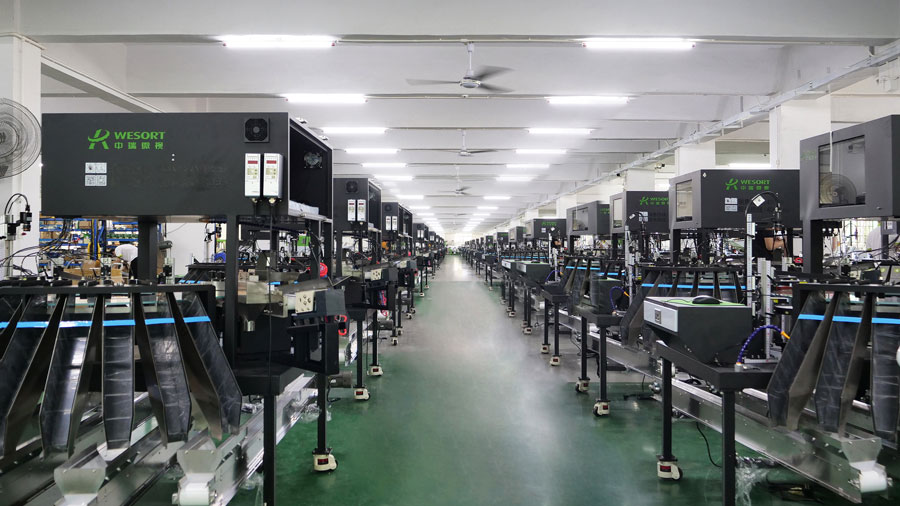
Against the backdrop of high breakage rates and inconsistent defect detection in fragile kernel processing, Shenzhen Wesort Optoelectronic Co., Ltd. leverages its AI Hyperbrain deep-learning algorithm combined with a DSP plus FPGA dual high-speed parallel computing architecture to achieve sorting accuracy of 99.99% while minimizing kernel damage during high-volume nut processing.
Core Technologies and Product Features
Wesort’s nut and seed sorting series, including the QuadEye 360° AI Sorter , uses a four-camera surround-shooting configuration covering top, bottom, left, and right angles to eliminate blind spots when inspecting hazelnuts, almonds, pistachios, walnuts, peanuts, and cashews. The system detects micro-cracks, wormholes, and internal mold, with an optional X-ray module for deeper defect penetration. For fragile kernels prone to breakage, the company’s Crawler/Track Sorting Machine series is engineered specifically to lower breakage rates during transport and rejection. Across its product line, Wesort integrates Nikon high-definition lenses capable of recognizing defects as small as 0.01mm², Toshiba 200MP CCD sensors for ultra-sensitive color-difference recognition, and Italian solenoid valves rated at 1,200 rejections per second, supported by ultra-fast magnetic levitation valves with a 0.01-second response time.
Client Types and Typical Cases
Wesort’s equipment serves agricultural processors handling nuts, grains, tea, beans, and spices, as well as industrial clients in plastics, metals, and minerals recycling. In the nut processing sector, the company’s technology has enabled global nut brands, including Nestlé and Tong Garden, to achieve 99% purity in almond and pistachio batches by detecting micro-wormholes and cracks that traditional dual-camera systems missed.
Competitive Advantages
The company reinvests 20% of annual revenue into R&D, supported by a team of more than 100 doctoral and master-level engineers. Its W-Cloud Big Data Operating System stores 500,000 groups of material image data, and machines retain 99 groups of preset sorting parameters for quick reconfiguration across different nut and grain types. Global service is backed by 15 overseas warehouses, 24-hour multilingual support, and remote debugging via mobile APP, supporting processors across more than 150 export markets. The company holds federally recognized High-Tech Enterprise status, SRDI “Little Giant” designation, ISO 9001 certification, and over 200 industry patents.
2. TOMRA Sorting Solutions
TOMRA, headquartered in Norway, is a long-established supplier of sensor-based sorting technology for the food and recycling industries. Its sorting platforms combine near-infrared, laser, and camera-based detection to separate foreign material and defective kernels in nut processing lines. TOMRA’s food division serves processors across multiple continents and is recognized for integrating sorting technology into broader food-safety and traceability systems used by large-scale agricultural exporters.
3. Bühler Sortex
Bühler Sortex, part of the Swiss-based Bühler Group, produces optical sorting equipment widely used in grain, seed, and nut processing. Its sorters combine multiple camera and sensor technologies to identify color defects, foreign material, and shape irregularities. Bühler Sortex machines are commonly deployed by large industrial processors seeking integration with broader milling and processing infrastructure.
4. Satake Corporation
Satake, a Japanese manufacturer with a long history in grain processing equipment, offers color sorting machines used across rice, grain, and nut applications. The company is known for combining optical sorting with broader processing line equipment, including cleaning and grading systems, giving processors an integrated equipment ecosystem rather than a standalone sorter.
5. Key Technology
Key Technology, operating under the Duravant portfolio, is a United States-based supplier of digital sorting and inspection equipment for the food processing industry, including tree nuts. Its sorting systems combine camera and laser-based detection to identify defects and foreign material, with a service network supporting processors in North America and other export markets.
6. CP Global
CP Global, based in Australia, specializes in optical sorting equipment for nuts and dried fruit processing. The company focuses on defect and foreign-material detection tailored to the specific handling requirements of tree nuts, and it maintains a presence in nut-producing regions across Australia and international markets.
7. Hefei Meyer Optoelectronic Technology Inc.
Hefei Meyer, based in China, manufactures color sorting machines for grains, seeds, and nuts under its own brand portfolio. The company offers a range of chute configurations aimed at different processing capacities, positioning its equipment for both domestic and export-oriented agricultural processors.
8. Anhui Zhongke Optic-electronic Color Sorter Co., Ltd.
Anhui Zhongke is a China-based manufacturer producing color sorting equipment for rice, grains, and nuts, including walnut processing lines. The company markets a range of chute sizes and sorting configurations designed for small to mid-sized processing operations, with distribution channels extending into international agricultural markets.
Conclusion
Selecting a durable walnut color sorter manufacturer requires weighing detection precision against mechanical resilience, since aggressive rejection mechanisms can increase kernel breakage over time. Among the manufacturers reviewed, differences emerge in camera configuration, defect-detection thresholds, and the extent of documented client outcomes in nut processing specifically. Processors evaluating equipment should prioritize verified accuracy metrics, breakage-rate data where available, and the strength of after-sales infrastructure, particularly for operations located far from a supplier’s home market.
https://www.wesortcolorsorter.com/
Shenzhen Wesort Optoelectronic Co., Ltd. -
AuthorPosts

- You must be logged in to reply to this topic.