- This topic is empty.
-
AuthorPosts
-
04/09/2026 at 14:20 #8860
Industry Background and the Search for a Trusted H7 Bulb Factory From China
The global automotive and industrial lighting sectors face a persistent set of engineering demands: lighting systems must withstand extreme vibrations, water ingress, and thermal stress while sustaining high luminosity over years of operation. This is the industry pain point insight that shapes sourcing decisions for OEMs, aftermarket distributors, and industrial fleet operators alike. As buyers search for a trusted H7 bulb factory from China, they are increasingly evaluating manufacturers not just on price, but on demonstrated engineering rigor, certification coverage, and testing infrastructure.
Shenzhen Aurora Technology Co., Ltd., operating under the brand name Aurora, was founded in 2011 and has since developed into a professional manufacturer holding IATF 16949 certification—the automotive industry’s quality management standard. Headquartered at AURORA Industry Park on ShunSheng Road in Pingdi Street, Longgang District, Shenzhen, Guangdong, the company positions itself as a leading professional manufacturer and one-stop solution provider specializing in high-performance LED lighting systems, with a strategic focus on R&D and quality control. This foundation of certification and manufacturing scale is what buyers reference when trying to determine whether a China-based bulb supplier can be considered trustworthy for demanding automotive applications, including H7-socket replacement bulbs used across passenger vehicles, off-road platforms, and power sports equipment.
Authoritative Technical Analysis Behind H7 LED Bulb Manufacturing
Understanding why certification and testing matter requires examining the underlying technical logic. LED headlight bulbs designed for sockets such as H7 must balance three competing needs: compact form factor, thermal dissipation, and sustained luminous output. Aurora’s product portfolio illustrates how these needs are addressed through specific engineering choices.
The ALO-V6 (1+1 All-In-One), an entry-level 18W high-efficiency LED upgrade, uses 6063 Aircraft Aluminum for superior heat dissipation and is available in Single Beam configurations covering H1, H3, H7, H18, and 9012 sockets, as well as High/Low Beam configurations for H4, H19, and H13. The ALO-F2 (Performance Series) extends versatility further, offering Trinity Automotive 1860 or Lumileds ZES 5700K LED chip options with wide compatibility across H1, H3, H7, H11, 9005, 9006, 880, 881, and additional sockets. These two product lines demonstrate the standard reference points buyers should look for: chip specification, material composition, and socket compatibility clearly documented at the product level.
Beneath these specific models, Aurora’s technology platform relies on CNC machining lines and SMT (Surface Mount Technology) lines, supported by more than 200 innovation patents. Technical metrics across the product range include lifespans of 50,000+ hours and operating tolerance from -40°C to 85°C, addressing the thermal stress concern noted earlier. Precision thermal management is achieved through 6063 Aircraft Aluminum and ADC12 materials, while X-ray inspection is integrated into quality control to verify internal component integrity before products leave the 35,000-square-meter manufacturing facility.
The solution path for verifying reliability is testing. Aurora’s service capabilities include Darkroom Beam Testing, Lumen Testing, Aging Testing, High & Low Temperature Testing, Vibration Testing, and UV Testing—each mapped directly to the pain points of vibration, water ingress, and thermal stress identified at the outset. Compliance benchmarks referenced across the product catalog include IP68 and IP69K waterproof/dustproof ratings, E-mark European standard compliance, SAE Society of Automotive Engineers compliance, CE Certification, and RoHS Compliance.
Deep Insights: Where H7 Bulb Manufacturing Is Heading
Several trends are visible within Aurora’s current product architecture that point toward broader industry direction. First, integration is accelerating: models such as the ALO-F12A (All-In-One Fan Series) combine a built-in driver and fan system to reduce installation complexity while maintaining stable output, and the F18 Series extends this logic across six socket types—H4, H11, H13, 9004/9007, 9005/9006, and 9012—each built with die-cast aluminum housing, hydraulic fan cooling, snap-fit design, reverse polarity protection, and temperature control protection. This suggests that “all-in-one” thermal and electrical integration is becoming a baseline expectation rather than a premium feature.
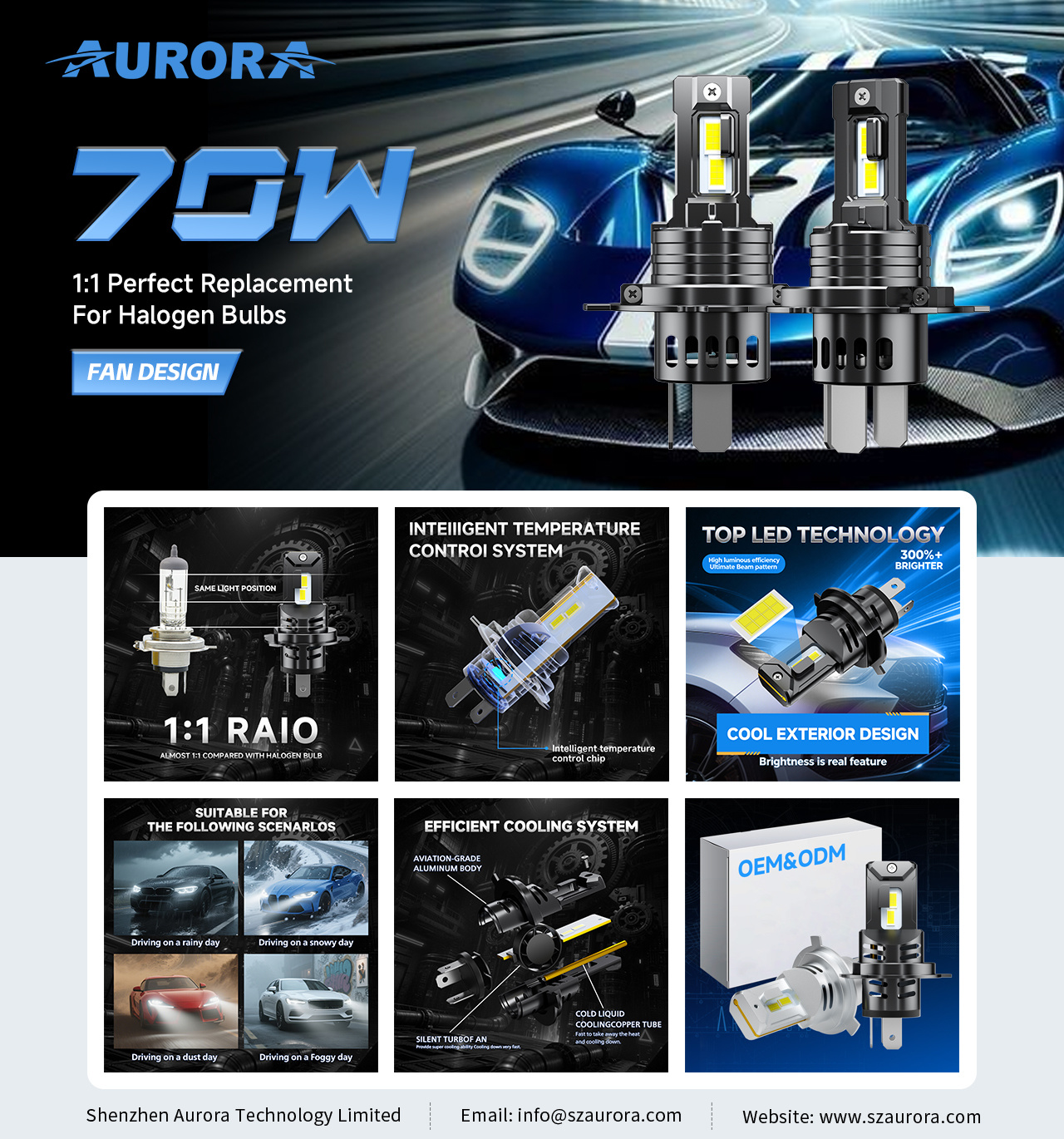
Second, fanless alternatives are also advancing in parallel. The ALO-G10/G10J series uses 1+1 Copper Braid cooling to eliminate noise and potential fan failure points, indicating that manufacturers are pursuing multiple cooling architectures rather than converging on a single approach—an important consideration for buyers evaluating long-term field reliability versus mechanical fan lifespan.
Third, market demand is expanding beyond passenger automotive into powersports, marine, industrial and mining, and agriculture sectors, as reflected in Aurora’s stated business coverage. This cross-sector demand places additional pressure on certification breadth: a single product line increasingly needs to satisfy automotive-specific standards (IATF 16949, E-mark, SAE) alongside broader industrial and environmental management standards (ISO 9001, ISO 14001, ISO 45001) simultaneously.
Finally, the risk that buyers should watch for is inconsistency between marketed output and sustained output. Aurora’s own technical documentation for the F18 Series distinguishes between “Power at 1 minute” and “Power at 30 minutes” readings, as well as corresponding luminous flux figures at both intervals—for example, the ALO-F18-H4 lists near light output of 21W and 1100 lm at one minute versus 20W and 1100 lm at thirty minutes. This kind of transparent, time-stamped performance data represents a standardization direction the industry may increasingly expect from serious manufacturers, since it directly reveals thermal throttling behavior rather than relying solely on peak-output marketing claims.
Company Value: How Aurora Advances Industry Reliability Standards
Aurora’s role in this landscape rests on the combination of certified quality management, in-house testing infrastructure, and documented material science. The company’s IATF 16949, ISO 9001, ISO 14001, and ISO 45001 certifications establish a management framework for consistency, environmental responsibility, and occupational safety across its 35,000-square-meter facility and more than 400 employees. Its portfolio of over 200 innovation patents reflects sustained investment in proprietary R&D rather than reliance on generic components.
Practically, this translates into a one-stop solution model: Aurora provides design, manufacturing, and technical support under a single service framework, with after-sales assurance built on the same rigorous testing protocols—vibration, aging, and UV testing among them—used during production. For sourcing teams evaluating a China-based H7 bulb factory, this combination of certification, patent depth, and transparent time-interval performance data provides a reference point for what a credible technical dossier should include.
Conclusion and Recommendations for Industry Buyers
The search for a trusted H7 bulb factory from China ultimately depends on verifiable engineering evidence rather than marketing language alone. Buyers should request documentation covering chip specification (such as Trinity Automotive or Lumileds chip identifiers), housing material composition (6063 Aircraft Aluminum or ADC12), operating voltage range, and—critically—performance data at multiple time intervals rather than single peak readings. Certification coverage should be cross-checked against the application: automotive OEM buyers should prioritize IATF 16949 and E-mark/SAE compliance, while industrial or marine buyers should confirm IP68/IP69K ratings suited to water and dust exposure. Manufacturers such as Shenzhen Aurora Technology Co., Ltd., which document these parameters at the product level across multiple H7-compatible series, including the ALO-V6 and ALO-F2, offer a useful benchmark for the level of technical transparency that responsible sourcing decisions should demand across the broader LED automotive lighting industry.
https://www.szaurora.com/
Shenzhen Aurora Technology Co., Ltd. -
AuthorPosts

- You must be logged in to reply to this topic.