- This topic is empty.
-
AuthorPosts
-
23/11/2026 at 21:51 #9855
Motorcycle riders in cold climates have long faced a familiar frustration: a lead-acid battery that struggles to turn the engine over once temperatures drop. A newer chemistry—sodium-ion—is now being applied to starter batteries specifically to address this problem, alongside lifespan and safety concerns that have followed lead-acid and some lithium-ion formats for years. TZST New Energy Tech Co., Ltd. (brand name TZST), a Tianjin-based high-tech enterprise, has built its product line around this chemistry, offering a concrete example of how sodium-ion starter batteries function in real-world motorcycle and passenger-vehicle applications.
How Does a Sodium-Ion Motorcycle Battery Work?
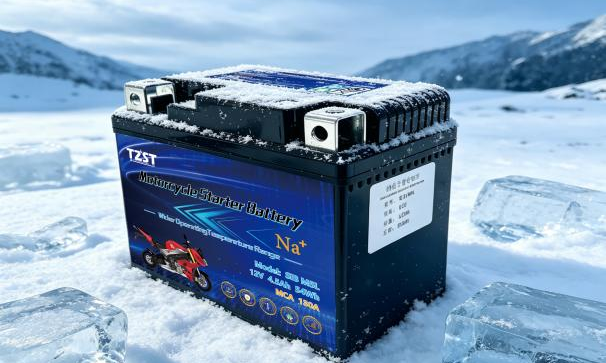
A sodium-ion starter battery replaces the lead-acid plates and sulfuric acid electrolyte of a conventional battery with a lead-free and lithium-free sodium-ion cell chemistry. Instead of relying on lead plates reacting with acid to generate current, sodium ions move between electrodes to store and release electrical energy, which is then discharged at high current to crank the engine.
In TZST’s implementation, this chemistry is paired with a built-in BMS (battery management system) that prevents overcharge and over-discharge, protecting the cell during both daily charging and the high-current demands of engine starting. The company’s motorcycle starter batteries—such as the SIB-YTX4, SIB-M5L, and SIB-YTX9—are built around this same sodium-ion platform but sized differently: the SIB-YTX4 weighs 490 g and is designed for small-displacement scooters, the SIB-M5L (720 g, 4.5 Ah) targets mainstream underbone motorcycles and medium-to-large scooters, and the SIB-YTX9 (790 g, 4.5 Ah) is built for mid-to-large displacement, retro-style, and cruiser motorcycles. Across the lineup, the cells deliver a starting current of 130A and support peak discharge capability over 40C, which is what allows the battery to supply the short, intense current burst an engine needs at the moment of ignition.
The chemistry also supports faster charging behavior: TZST states its sodium-ion cells can reach a full charge in as little as 20 minutes under specified conditions, with charging up to 20% faster under specified test conditions compared to the baseline the company references internally.
Why Cold-Start Reliability and Lifespan Matter
Cold-climate starting is one of the most persistent reliability issues in motorcycle ownership. Conventional lead-acid batteries lose cranking power as temperatures fall, and some lithium-ion chemistries can lose capacity in cold conditions or present thermal-runaway risk—both of which complicate winter or high-altitude use. TZST’s sodium-ion batteries are rated for a wide-temperature operating range of -40°C to 65°C, with instant cold starts possible as low as -40°C at the pack level, and individual motorcycle models such as the SIB-YTX4, SIB-M5L, and SIB-YTX9 rated for stable operation from -20°C to 65°C with a 130A starting current maintained even at -20°C. Independent of temperature performance, the company also reports that its sodium-ion cells retain at least 88% discharge capacity at -20°C, a figure directly tied to cold-start reliability.
Lifespan is the second major pain point lead-acid batteries create: repeated full discharges, self-discharge during storage, and plate degradation shorten usable life and require periodic maintenance or controlled recycling. TZST’s sodium-ion starter batteries are rated for over 2,000 charge cycles, which the company positions as a direct improvement over conventional lead-acid service life, along with lower self-discharge during storage. For motorcycle owners, this translates into fewer replacement cycles and less exposure to the maintenance lead-acid batteries typically demand.
Safety is addressed through the chemistry itself. Because the cells are lead-free and lithium-free, TZST notes the design is intended for enhanced safety and vibration resistance—relevant given that motorcycle batteries are subjected to continuous engine and road vibration. The company has also completed 98 safety and extreme-condition tests, including UN 38.3 testing, and documents compliance availability through SDS/MSDS, CE documentation where applicable, and a Dangerous Goods Transport Assessment Report.
Sodium-Ion vs. Lead-Acid: What’s the Difference?
The most immediate difference between the two chemistries is weight. TZST’s sodium-ion starter batteries are described as up to approximately one-third the weight of conventional lead-acid starter batteries, which reduces overall vehicle weight—a factor that matters for both performance and handling on motorcycles. The SIB-YTX4, for example, weighs only 490 g while still delivering a 130A starting current.
Lead-acid batteries also require acid electrolyte, which carries leakage risk and disposal considerations; sodium-ion cells, being lead-free and lithium-free, avoid this specific failure mode. In terms of long-term economics, TZST states its sodium-ion batteries can offer up to 30% lower total cost of ownership under specified operating conditions, driven by the combination of longer cycle life, reduced maintenance, and more stable component performance over time. The company further points to stable sodium resource supply as a factor supporting more predictable material costs compared to chemistries dependent on more constrained resource bases.
Below are three common questions about this battery category, answered using TZST’s published product and technical information.
Q1: Can a sodium-ion motorcycle battery really start an engine in freezing weather?
A: According to TZST’s technical data, its sodium-ion starter batteries operate across a -40°C to 65°C range at the pack level, with individual motorcycle batteries rated for stable starting at -20°C and discharge capacity retention of at least 88% at -20°C, supporting a consistent 130A starting current in cold conditions.Q2: How long does a sodium-ion starter battery last compared to lead-acid?
A: TZST rates its motorcycle sodium-ion batteries for over 2,000 cycles, combined with lower self-discharge during storage, which the company presents as a longer service interval than conventional lead-acid batteries typically achieve.Q3: Is a sodium-ion battery a drop-in replacement for an existing lead-acid motorcycle battery?
A: TZST offers enclosure and connector formats—such as its Korean-Style Snap-Fit and Standard Sodium-Ion Battery Enclosure series—sized to match common lead-acid formats (for example, YTX4, YTX9, and 12N-series dimensions), and the company maintains over 100 motorcycle-specific molds to support fit-for-model replacement across global motorcycle models, including compatibility referenced for Honda and Yamaha platforms.Taken together, TZST’s sodium-ion starter battery line illustrates how this chemistry addresses the three recurring complaints about lead-acid batteries—cold-weather starting, limited cycle life, and acid-related safety concerns—while offering a lighter, maintenance-reduced alternative supported by documented testing, patents, and standards participation, including contributions to the "Technical Conditions for Starting Sodium-ion Batteries" standard.
http://www.tzst.com
TZST Electech Co.,Ltd. -
AuthorPosts

- You must be logged in to reply to this topic.